One phrase I keep on hearing in the School is, 'Times have changed ...,' to explain why there isn't the commitment, or the numbers, or whatever it is. Anything unsatisfactory in School - to which there appears to be no answer - is laid at the door of Times Have Changed.
So common is this phrase that it is never challenged. At the turn of the 20th century Beatrice Webb (of the social reforming duo Sidney and Beatrice Webb) used to declaim to visitors that 'Marriage is the wastepaper basket of the emotions.'
Whether or not that is the case, Times Have Changed is certainly the wastepaper basket of the School. If you don't like something - you know in which direction to throw it.
Now Times Have Changed, although I'm not revealing any secret by saying that is nothing new.
But that poor old wastepaper basket is a dull sapper of energy. It shouldn't go unchallenged.
Thursday, October 19, 2006
Below the parapet - words

Monday, October 16, 2006
Principles
When I met with Mr Lambie a few weeks ago to discuss this web site I said that I would establish some guiding principles. Here are some, along the lines of Socrates' Daemon which told him what not to do.
1. Don't Break Confidentiality
One of the dangers of the medium is that people become more prone to gossip than they would otherwise be. People need to feel able to speak in School gatherings without fear of it being repeated elsewhere. Having said that, there are many cases where someone will say something that sparks off a thought that needs to be pursued. There's no reason that this can't be done without a traceable direct quote. We do need to be able to speak about a principle.
2. Don't Violate Anonymity
If we know or can guess at someone's identity this information should not be shared around. It is no business of anyone else if someone wants to participate anonymously.
3. Don't Infringe Copyright Without Permision
This would include course material and private communications.
4. Don't Criticise
Another principle of the School is that one should not criticise others. If people want to give vent to their feelings, they probably know where to do it. We can still have a clear sense of what's right and we don't need to accept wrongs, no matter how old or practiced they are within the organisation.
Apart from this I think that people can use their own common sense when taking part in the web log. If you have any comments, please let me know. Or if you would like to make suggestions, please do.
Saturday, October 14, 2006
RIP Vayukesha
It is with great regret that I must announce the departure of Vayukesha, my former alter-ego. One ego per body, altered or not, is more than enough.
Read moreThursday, October 12, 2006
The Three Questions
Many years ago my father went on a management course and he told me about the 3 sentences all managers need to learn to say:
"You did a great job there."
"I'm sorry, I made a mistake."
"What do you think?"
What strikes me now about these sentences is that they are double-edged. On the one hand, they're intended to liberate the employee; on the other, they're intended to create humility in the manager.
The first seems the easiest and maybe the least interesting. Praise can be either genuine and deserved, or it can be fake and a way of asserting one's authority: I am the person who pats you on the head. Maybe it would be better to enthuse.
The second is crucial. Earlier this year the leader of the School took this step for the first time. We used to say, "being a tutor is never having to say you're sorry" (that's the kind of group we are, I'm afraid!) ... but it seems that the School can now learn to say that sentence.
It prepares the way for the third sentence, which is the most important of all. It's easy to express appreciation and retain one's power; it's even possible to apologise, and still avoid real humility. But to ask people their opinion - really ask them, as in wanting to hear what they think and being prepared for their answer to make a difference - is surrender. It is the spiritual question.
Many years ago, the Economics faculty was deader than Henry George's dog. Occasionally there seemed to be a twitch of activity, but it might only have been a trick of the light. Hard to be sure. Then one day they did something extraordinary. A survey was sent round to every young member of the School, asking what our economic concerns were. I completed it as best I could, and at the bottom of the form remarked, "This is the first time in all my years in the School that I have been asked a non-rhetorical question."
Since then the Economics faculty has staged a revival: it started to study economists other than the Blessed Henry ... made connections with other organizations ... begun to address the needs of the world in which we actually live. All of this has nothing to do, of course, with what I wrote on that form, or in all likelihood with what anyone else wrote. It was a change of heart. For some reason the faculty had stopped thinking it had the answers already, and asked a question to which it did not know the answer.
It's probably fair to say that the School as a whole is now at the point that Economics was a decade ago. Every week brings news of the departure of a philosopher, and the deaths of two more. Soon there will not be enough students left to complete the daily rearrangement of deckchairs on the HMS Titanic. The organization as presently configured doesn't know what to do next.
How bad do things have to get before we ask the question?
So, what do you think?
Wednesday, October 11, 2006
Reduce the Damage, Not the Student
The following might relate to some of the recent discussions on how to effect change.
I recently spoke to a lady – let’s says she’s in the London School – who has a great problem when she goes on residentials. She’s an environmentalist, and she’s horrified by what she sees at School properties. Minimal recycling, widespread and indiscriminate use of chemical sprays and fluids, low-energy light bulbs nowhere to be seen, coal-burning fires blazing on a warm day … she says “it hits me in the solar plexus”. She can hardly bear to be on a weekend, let alone a week, because it conflicts so much with her way of life and her ideals.
She has been told repeatedly that she has to surrender this agitation. In a sense, this is merely the traditional School view. If there is agitation, it must be coming from ahankara: therefore surrender. Unfortunately, this tradition contradicts the Shankaracharya as well as reason. His Holiness does indeed recommend surrender if there is agitation, but he also says that having surrendered the agitation we should do something about what caused it. To use an extreme example, I might feel agitated if I saw a man about to murder a child; I have to collect myself, and then act to stop him.
I said to this lady that she must write to the authorities within the School and explain her views. She will never find peace until she does so, because to do nothing is to condone a wrong. Environmental concern is not only in accord with the principles of our philosophy and economics; it is central to it. Within the Indian tradition, the spiritual journey corresponds to a lessening of environmental damage as life proceeds. Eventually the forest-dweller and the sannyasin reduce desire to the point where the consequence of his existence is almost nil. Our present practices ignore this aspect of the teaching, and so this is an opportunity to evolve the School.
'Surrender the agitation' is partial truth, a dangerous thing. “One cannot simply put a stop to the stream of life”, says His Holiness. The way forward for the individual as well as for all, is to direct the stream into its rightful channel. We need to learn the importance of speaking up for what's right.
Sunday, October 08, 2006
Deep Thought
"The Indians have had mantra for quite a long time. If you look at the state of India, you have to say that mantra cannot be the answer to everything". - Language lecture 2006
This seems logical and reasonable, but for many years we've had a faith in meditation as the answer to everything (along with satsanga, which the Indians have also had for a while). Is it the answer?
If so, to what? In part or full? And how?
Friday, October 06, 2006
Elderly Germans In Action
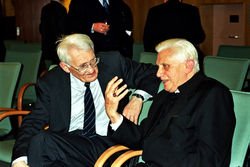 Recently James posted a comment about Pope Benedict XVI's controversial speech. A while back I mentioned that the Pope had been in dialogue with a modern left-wing philosopher called Jurgen Habermas (left). It turns out to be fascinating.
Anyone who is interested in the meeting point between the paths of faith and reason should read this excellent article from Prospect magazine.
Thursday, October 05, 2006
Names
After considering the many suggestions put forward, I've decided to change the name of this weblog to "At the Crossroads".
It suggests the importance of sometimes stopping to re-assess, and an informal meeting place where important matters can be considered. It suggests a place from which to view options. It says something about the significance of this moment in the history of the School, almost 70 years on.
Maybe (although I didn't think of it at first) it might remind you of the new premises of the London School in Mandeville Place.
Thanks to everyone who offered their suggestions.
Two Cheers For The Uncharismatic Leaders!
Following on from some of the conversations in recent posts, I'd like to show how a principle can and should be examined in practice. This isn't contradicting what anyone else is saying, but clarifying my own view.
Let's consider the idea that a principle is "a thorn to remove a thorn; when you have made use of it, you throw both away".
It's not a difficult concept in theory, but in practice it seems to cause people all kinds of problems. Let's assume that this idea is true. It describes a finite process. But how long should it take? Either (a) until full self-realization; (b) until a stage of understanding is reached beyond which the individual is capable of independent reason; or (c) until the Teaching has been heard in full and is intellectually known about.
We can dismiss (c) because we know that intellectual appreciation is not enough. We have to make use of the Teaching to remove the thorn of ignorance. We can also dismiss (a). It would be unreasonable to say that the Teaching should be carried about with us forever like a crutch. Not only that, it conflicts with the tradition of the teacher giving the student rahasya and sankalpa - the secret knowledge, and the ability to decide things independently. At this point, the student is no longer a student, but an independent seeker. So if we believe in the tradition we have to accept that at some point between the extremes of total ignorance and total enlightenment, we make use of a thorn, remove a thorn, and then throw both away. There may be more thorns of ignorance and therefore more thorns of knowledge needed. It's a matter of little steps in knowledge, but little forward steps.
If we look at how things are in the School, it might seem as though almost no-one has achieved such a thing. The tutor reads something to the group. The student asks a question. The tutor re-reads the passage. Another question. Another re-reading. How many tutors can hear what is being said and understand it? How many are clear enough about what is being said to explain it in their own words? His Holiness said, "no-one needs to bind himself to a word". How many of us have transcended the word by finding its meaning?
The only way to come at this is to look at examples of apparent transcendence. We are not talking about full self-realization, but about where someone seems to know something independently. There are a few candidates - I've mentioned Mr Jaiswal before; I might also mention Shane Mulhall, whose talks I've been listening to recently. It's a funny thing, but he stands out in that he doesn't really stand out. He's kind of ... uncharismatic. He has a sad, sonorous voice, and a strange gasping laugh when he tells a joke. From his descriptions of his life (most frequent word used "pathetic") he spends time watching football on the TV, he worries about what suit to wear, and loses arguments with his wife and children. In short, he's an accountant.
Why, then, is he so universally loved and respected? It's obvious. He knows what he's talking about; he speaks from the heart; and he lives by his words. Cut him any way you like: you can read the principles of the teaching there like Brighton rock. You might not agree with everything he says, but he doesn't mind that; nor does he imagine that he's got all the answers because he has the books on his shelf. He quotes His Holiness liberally and faithfully, but with a light touch that only comes from knowing the truth of it for yourself. The result? Someone told me the other day that there are 14,000 students in the Irish School. I've no idea whether that's true, but if so it's a great testament to what can be done.
The problem with charismatic leaders is that you can't do without them. We have a few of these types knocking around - masters of the world etc etc - and the problem is that once you accept their help they make you dependent. In the end, it's not very attractive. The real teacher doesn't make you feel how wise they are, but gives you a glimpse of your own native wisdom. The real teacher sets out to make you equal to himself.
But to come back to thorns - how many of us have forgotten that the Teaching itself is a thorn, and that life is not about the Teaching? How many of us have neglected our Self, in our anxiousness to praise the Teaching about the Self? How many of us have bound ourselves to a word? The Great Men who trumpet their virtues don't do that. Neither do the wise. It's the rest of us, rubbing along together in the lowing herd. That's how we keep ourselves the same.
Wednesday, October 04, 2006
Change
“Great minds discuss ideas;
Average minds discuss events;
Small minds discuss people”
~ Eleanor Roosvelt
Much to my surprise I recently heard a someone in the school use the 'L' word; logic that is. The point was that it is a basic premise of logic that you cannot go from the particular to the general. The above quote came to mind and the thought arose that if we start to generalise from the basis of particular people or events then want to create change on that basis then that is a shaky foundation to start from.
If there are problems at the level of people and events (I come across loads including experiencing myself on an average day) then the question must be, "How do we get back to a true understanding of the IDEA, the principle?". This may or may not involve change.
What concerned me about V's last post was the possibility that too many people focussed too much on change means taking your eye off the changeless. I don't aim this coment at V personally, just something that concerns me generally. I also relate this to the notion of the name for the blog being, "A School for Today and Tomorrow". The effect it creates here is to think that the blog is some kind of think tank that is going to suggest what the school should be. That may not be the intention but that is how I hear it.
From a more practical point of view when I first started going on residentials, I was asked to wear a suit and tie. Initially, I never gave it a thought as to whether this was good or bad. Just accepted it. Now, my preference would be not to. But to get caught up in arguing about whether it's good or bad is perhaps not a very good use of the mind? It's fairly superficial one way or the other. And the more the mind gets caught up in the details, the arguments, and remains focussed on this then does the changeless get forgotten?
Some might say here that I am advocating doing nothing. Well I am well practised at doing nothing but that's another matter. I feel and it is the experience that a principle deeply understood leads to inevitable change (or inevitable confirmation that what you are already doing is correct). This cannot be a purely theoretical/intellectual grasp of a principle but something that has penetrated into the being, the 'emotional truth' spoken of elsewhere. For example, I became vegetarian on the basis of health and of minimising harm to other beings. The principle was felt as well as thought, then the change was inevitable from this. It has never really been a practise or a discipline, more like a change of behaviour that results from something understood. The converse side of this is to make change without having deeply understood. Maybe it is the correct principle but the results are temporary or shallow or maybe even detrimental.
I just want to make it clear that I am not personally calling for any particular change, nor do I feel qualified to do so. But I do want to question. I want to question because I want to understand. I want to get back to the true idea, the true principle. And I am sure that there are others in the school who already understand the principles better than I do. But as has been said elsewhere, being told the 'right' answer is of only partial use and can even result in unhealthy passivity or 'shallow' change as described above. So I want to question, not to change things. But this also does not deny the possibility or change arising naturally from understanding.
Sunday, October 01, 2006
Today and Tomorrow
I don't know if Art in A. has ever been 'cutting edge', but it has always seemed special. Are we in danger of losing that? It's all very well to faithfully carry on the work of the past, but the real task of youth is to renew, refresh and sharpen. That means a clean slate on which to re-imagine the event. We've got to 30 years, and if we're to last the next 30 we need a new, inspiring plan. We need to consider 'AinA 2036'.
There's no lack of talent or intelligence to do this, but there is a question mark about the will. Are we prepared to think boldly, to set a new agenda for the future? Are we prepared to do things differently?
There are a lot of suggestions I could make as to what we could do, but the real need is for someone in authority to ask the question - what do you think? - of all of the new generation of staff, and be prepared to take the answer seriously.
The same could be said of the School as a whole, of course. Maybe the title of this blog could be "A School for Today and Tomorrow". Hmm ... I think I'll live with that for a few days.
What do you think?
Friday, September 29, 2006
Creating the Container for Satsanga
Following on from V's 'Upanishad' post:
The Upanishads begin with an invocation. What is the purpose of the invocation? Presumably to prepare heart and mind so that it is receptive to what is to come? But also, using the definition of upanishad as 'sit near' this implies an intimate gathering, like Jesus sitting with his disciples rather than speaking to the masses. I find myself returning quite regularly to "saha naavavatu" from the Katha. The more I look at it the more it implies to me a preparation, creating the conditions for satsanga to take place. It could be useful to look at it as a guide to 'preparing the ground' for a true meeting. Some reflections:
1) may we be protected
- the satsanga is a safe environment where we can open our hearts and trust that we will be met from this place
- confidentiality is understood
The umbrella of protection is a propitious environment whereby:
2/3) may we be nourished / may we create strength
- the satsanga provides spiritual food whereby the being is nourished and strengthened
- from this it is possible to re-engage with the world on leaving the satsanga with greater detachment, purpose and natural discipline
- there is strength to resist the negative / various pulls of the world etc through the force of being
4) may our studies be illumined
- may the reason / intellect be lit up with clarity
- may the light of intelligence shine without hindrance
- may there be true understanding
5) may we not oppose one another
- no envy or competition
- drop any past disagreement, conflict etc that puts up a barrier to meeting NOW
I'm sure this is not exhaustive. Just some of the things that are evoked. Any other pertinent suggestions welcome.
I have used this prayer with some regularity before attending group. It does seem that the intent and the effect is to prepare oneself better for what is to take place, also (for the devotionally inclined amongst us) to ask the Absolute for help in this matter.
"For wherever two or three are gathered in My name, there I AM in the midst of them."
~ Matthew 18:20
Thursday, September 28, 2006
Tighten or Loosen?
I recently read a great book by American psychologist Jonathan Haidt, called The Happiness Hypothesis: Putting Ancient Wisdom and Philosophy to the Test of Science. Haidt draws on the great teachings and asks whether what they say is supported fully, partly or not at all by science so far.
One paragraph has kept coming back to me, because it contains a simple fact that challenges my own thinking about the benefits of philosophy. Here it is:
Clinical psychologists sometimes say that two kinds of people seek therapy: those who need tightening, and those who need loosening. But for every patient seeking help in becoming more organized, self-controlled and responsible about her future, there is a waiting room full of people hoping to loosen up, lighten up, and worry less about the stupid things they said about yesterday's staff meeting or about the rejection they are sure will follow tomorrow's lunch date. For most people, ... [the instinctive self] ... sees too many things as bad and not enough as good.
Instinct is a pessimist, because that's how you survive in the jungle. The consequence of missing an opportunity for a meal is relatively minor, compared with the consequence of becoming a meal for something else. That also applies to things like prestige: the Alpha Male is only as good as his last scrap. Win a hundred battles, all you get is another day in power. Lose one, and you're out. We are pre-programmed to be more fearful than hopeful.
But the observation of the psychologists troubles me, and I wonder if it does you.
The School has always advertised itself as offering ways to become "more organized, self-controlled and responsible", and only secondarily aimed to help people to loosen up. We lighten up, according to the School, only when we become disciplined. To be disciplined is, as His Holiness famously said, to "flow freely". What we do with this is to re-frame "lightening up" as being no more than a side-effect of adding discipline to life. The world is sliding into disorder, anarchy, atheism and immorality, and we have the answer - more discipline. Stop whinging and get back in that trench, you idle, complacent layabout!
Even more troubling than the thought that we might be losing customers by our approach, appealing to the odd one out rather than responding to the needs of most people, is the implication that we are perhaps siding with the instinctive, habitual nature against reason. That's to say, if basic instinct makes me worry too much, and I fill my conscious mind with worry as well, then I am going to become more repressed, more neurotic, more miserable. And in some sense, this seems to fit the stereotype, if not the inner reality - enthusiastic, cheering crowds in part 1; grey suits and silence later.
It may be that the world is getting too free-and-easy. Let's grant that it is, for the moment. Does that necessarily mean that a corrective prescription of heavy discipline and hard work should be administered? Have we the responsibility to weigh in the scale of discipline?
I don't have the answer to this, but one begins to suggest itself. I believe that HH is right about discipline and free flow, of course, but I also believe that we've interpreted him wrongly somewhere along the line. We must have done. I would come back to his classic formulation, "tender advice, showers of love, or a little hard discipline". It seems that His Holiness wants us to be careful about how we use the negative, but to pour on the positive without any limit. If human beings really are saddled with a base nature that makes them worry too much, then it must be so that encouragement, enthusiasm and hope are what they need. When we have reassured people that they don't face a threat, then perhaps we can employ a little hard discipline, but with the lightest of touches.
Monday, September 25, 2006
Brahma, Vishnu, Shiva
Much of the discussion on this blog has centred around structure and how that relates to freedom of expression or freedom of enquiry. The thought arose a while ago as to whether 'preservation' can or should exist in isolation from creation and dissolution? Is Vishnu 'preserver' or does he use all three aspects of creation, preservation and dissolution in order to 'preserve' ?
The Shankaracarya gives the analogy of the Ganges flowing down through the Himalayas towards the sea. The mountains are said to be the religions. How do they become mountains? By preserving themselves and not flowing? How do we become rigid? How do we dissolve and become creative again?
Gita, Ch4, V8 is really intriguing with regard to this question, containing all three aspects:
'To protect (preserve) the righteous, to destroy (dissolve) the wicked, and to establish (preserve) the kingdom of God, I am reborn (create) from age to age.'
(look up the sanskrit if you're so inclined!)
So the question is:
- are creation, preservation and dissolution three separate things or
- is the true 'preservation' the interaction of these three forces?
The latter definition allows for a tradition to:
a) be revitalised, re-invigorated, re-energised, re-formed (creation)
b) throw away what has become habitual, mechanical etc (dissolution)
c) protect what is 'established wisdom' (the usual definition of preservation)
and then the true 'preservation' results from all three, wisely used.
(In fact in writing the above three 'categories' it becomes difficult to separate them – dissolving and revitalising are the same thing in the same way as cleaning a window involves removing the dirt. And is preservation something separate from these apparent two? If so, what?)
Changing the Name
It's become clear to me that we need a new title.
When I started "Free the Teaching!" it perhaps reflected accurately my feelings at the time, following the Inquiry Report and the Channel 4 news piece. On the one hand, the leadership was advocating change, reflection and progress; on the other, there was the sense that some were more concerned with damage limitation. The aggression of our opponents was being returned tit for tat. I was frustrated with this, and I had lost much of my respect for the reactionaries. In short, I wanted to have a go.
Of course, that was not my only motivation. I had also come to believe that our problems were not the result of malignant outside forces, or (even worse) of any shortcomings in the Teaching as we have received it, but of a failure to fully understand that Teaching or put it into practice. So "Free the Teaching" also represents a call for all of us to stop limiting the Teaching with our ideas about it. This was not a woolly or sentimental view - I had some clear ideas about what we had got wrong, and about what needed to be done to put it right. I wanted to test those ideas on others.
Maybe the most important point I wanted to make was that it is time for all of us to take a stand and stop relying on something external to us called "the Teaching". We need to recognise that ahankara is not original sin, but an illusion. There is something called the self, which is what we really are - not just in samadhi or when we reach an imagined Himalaya of the spirit, but what we are here and now, whether or not we know it. The ego distorts things, of course; but its effect is entirely peripheral to the self, and to our essential nature, which is particular to us, but also pure. Our talents, our affections, our deeper impulses and emotions are all routes towards the self (or, if you must, the Self). I'm OK, and you're OK as well. That is what His Holiness is telling us.
What worried me most was to see that there was so much despondency around. Some people were furiously hanging on to their old view of the School; those that had dropped that were, on the whole, losing their faith in it. If we were to procure a Guna-Meter from somewhere (can you get them on mail-order?) I think that the needle would have been pointing towards T and dropping. In order to get back to the S, we had to have some R.
Anyway, maybe that has been done enough. I'd like this blog to retain its edge and bite, where necessary - those are aspects of reason, after all; it has to be a forum for open discussion, where people can express their views freely; but perhaps with a little less heat, and a little more light.
So - we need a new name ... click "comments" below and have a go.
Friday, September 22, 2006
Upanishad
Question: Is it right to assume that the words of those we believe to be wise are true?
It might seem as if the answer is self-evident to any right-thinking philosopher. But something in me keeps saying "no". It seems to be an argument that I have been having for many years. I remember someone once saying to me with some annoyance, "your group doesn't seem to be able to accept that the Teaching is true". That man has long since left the School; practically all of my group are still around. There is something that we seem to have been hanging onto, no matter what people have tried to tell us. I woke up very early this morning, with the tail end of Hurricane Gordon battering rain onto the Velux windows, and it gradually came to me what it might be.
The problem I have is that I believe it contradicts the Upanishads to say that their words are true, and it contradicts His Holiness to say that his words are true. And although I can see that we need to treat these sources with reverence, in the end I do not believe that we should contradict the Upanishads or His Holiness, even if it seems to be in support of them. I will explain what I mean.
The word "Upanishad" means literally "to sit near", but in the Upanishads it is usually used with a different sense, that of "secret knowledge" or "hidden teaching". Another word used to say the same thing is rahasya. What is the secret knowledge? It is the knowledge of satyasya satyam, "the Truth of truth". Truth is prana, the life force; and the Truth of truth is that which cannot be defined: the consciousness of the Atman. It is wrong to say that the Upanishads are true, because they offer not truth, but the hidden knowledge of that which is true.
What is said about knowledge is that it is of two kinds, higher and lower. There seems to have been a view in the early Upanishads that lower knowledge was the ritual knowledge of the Brahman priests, which was intended to get a result. The Upanishads themselves were "higher knowledge" because they aimed at no result. Possibly later, or perhaps together with this, a second view emerged, which is if I may say a more refined concept, that the lower knowledge includes everything that can be expressed in words. The higher knowledge cannot be expressed: it is not in speech, but in that by which speech is known.
His Holiness says the same thing, when he says that knowledge of the Absolute and the Self is just ordinary information. It has to be transformed into understanding. This was why he told the translator of the Conversations, "don't listen to my words - listen to my meaning, and translate that". This might seem to represent a slippery slope. The Conversations are supposed to be "unalterable", and if we take that away, the reasoning goes, what do we have? What is the School?
The courageous answer to this, I would suggest, is that if the School is nothing without having a claim to "unalterable" texts, then it is indeed nothing. Only Fundamentalists have unalterable texts, and the reason for that is that they are too poorly educated and led to penetrate to the meaning. But the School is not and never has been about such a claim. A spurious claim on the truth cannot lead to truth.
People don't need the words: they need the meaning. And we come back again to the literal meaning of the word Upanishad: "to sit near". It presents an image of the teacher and the student, sitting together. In one of the Vedic invocations that opens an Upanishad we find the moving prayer, "may we not cavil at each other". Why? Because if we are to be united by truth, there is no room for petty emotions.
And that is what Shantananda meant when he spoke of higher knowledge (and here, he exceeded what is to be found elsewhere in the tradition) as the understanding that arises at the meeting of chittani ("hearts and minds") joined by love or common purpose. The same, he said, may not arise again away from such a meeting.
Those we love are those to whom we can tell the truth. All we need to do to benefit the world is to tell the truth.
Tuesday, September 19, 2006
Don't Mention the Camel
One thing that comes across forcefully from the study of the Indian tradition of philosophy is its simplicity.
It's easy to miss this if one's knowledge of it is entirely mediated through a group. If a term is spent studying five verses, it is likely that most of us have forgotten verse 1 by the end. It can become a bit like studying a flower by training a powerful microscope on it - one loses the sense of a beautiful object that can be appreciated immediately and in its totality, without a lot of thought.
Not that Advaita Vedanta is "philosophy for dummies" - not at all. But it can seem as though we can't see the bigger picture because of our love of close analysis. And then, when someone asks us what 'philosophy' means, we are stuck for an answer. It's a bit like the old story of the seven blind men describing an elephant. I'm sure that a blind man could tell me amazing things about an elephant's knee - its texture, its smell, its bulk - but I would not for that reason wish to be blind. We privilege the fine detail at the expense of the eye's ability to take all in at a glance. Both are needed.
The antidote to this is to read the Upanishads or the Gita oneself - not taking years over it, but reading 20 pages at a time. Read an Upanishad at a sitting, or even two Upanishads. If you find a bit that's obscure, don't fret about it, just skip on and come back to it later. Dip into the Vedas. Or read a modern Advaitin such as Nisargadatta, Ramakrishna or Vivekananda.
Another valuable approach is to read a good Western account of Indian philosophy (I'm currently reading Paul Deussen's The Philosophy of the Upanishads). Why? Because some things are too obvious for an Indian to mention. It's the same reason why there are no camels in the Koran - they were so common that there was no need for an Arab to go on about them. So if we want to get the Upanishadic spirit, we need to understand not only the words on the page, but also those that are present but not on the page.
Or, you could go along to a class offered by one of the many Indian centres of learning. I understand from more than one friend that the Chinmaya organization has some superb teachers. Apparently it's an excellent complement to School study.
When I was a child I had a board game that said, "A minute to learn - A lifetime to master". It might take more than a minute to learn Advaita Vedanta, but it doesn't take a lifetime. Get the basics under your belt, in whatever way you can, and devote your life to mastery.
Thursday, September 14, 2006
The Good, The True and the Beautiful
Traditional Western philosophy has proposed three objectives: the Good, the True and the Beautiful.
In the modern world, it has been noted by a number of commentators that we have emphasised the True at the expense of the other two. Science acknowledges only the standard of truth - speak to a scientist and ask whether he would allow ethical or aesthetic considerations to intrude on his experiments. Ethics are of course used to regulate science, but these are established from outside - by government, for example. Aesthetics are the realm of artists, and are even less important to the scientist, at least while he is being a scientist.
It should also be noted, however, that there is a secondary aspect to our tradition, which we derive from the Romantic era, that emphasises beauty and also truth. Keats' Ode on a Grecian Urn makes the classic statement:
'Beauty is truth, truth beauty,—that is all
Ye know on earth, and all ye need to know.'
The first problem with this is that it leaves out the Good - the moral or ethical. The second is that in practice beauty is well on top in the Romantic spirit. It is the personal response that matters - ie 'feelings' - and so we lose sight of Truth that may not accord with our personal feelings. In extreme cases, all that matters is what I feel; if you feel something different then you must be wrong, because the Beauty I experience is Truth. This is why art is greatly fragmented - standards are determined independently by the aesthetic responses of each artist or by each viewer of art, and not by reference to something outside of the individual.
What we seem to leave out, then, is the Good. Our society has things that it values as absolute ethical standards - universal equality, compassion, tolerance, charity, etc - but where do these standards come from? What inspires us? The answer still seems to be religion. Despite all that has happened over the past couple of centuries, we still do not have the Atheist Cross or the Secular Army rushing out to help people in need when disaster strikes.
This is why we need philosophy - some means to find inspiration that is not tied to faith - and yet we should also ask ourselves whether the School is not as culpable as anyone else in our neglect of the Good. We have upheld the True, and the Beautiful (not so much in our art, but in our emphasis on meditation, the exercise and similar practices that create an aesthetic or devotional experience) but have we done as much for the Good? We uphold principles and ethical standards, but how far? How real is our Good? Do we do good in society, or only in School?
Leaving aside issues such as charitable work, we might also ask whether kindness and compassion have not been neglected, in our efforts to exalt Truth. The Good is not in conflict with Truth, or with Beauty. We have perhaps more to discover about the harmony of all three.
Monday, September 11, 2006
Sanscrit - grrh .... or wonderful!
I have problems with Sanscrit grammar in a similar way to some people with meditation. I can't really see the point of it. Whereas with meditation the result is - or should be - a matter of indifference, with Sanscrit grammar there's a definite aim: to learn the language.
Why do we have to do this? What has Sanscrit got that can't be found in English? There are words, it is true, to describe states or conditions that can't readily be expressed in English, but the grammar itself is said to yield a mysterious knowledge, along with its cohort - the sounds themselves.
Mysterious certainly for me, obscure, floundering and the light never seems to dawn. It's a long hard path, a puzzle, more like a maze. And I never remember how I got there or where I'm supposed to be going. All the usual signposts have been turned around. Nothing very useful is retained.
I have asked others if they have experienced knowledge simply in the sound of Sanscrit. One said he did once but was not able to describe it.
HH has said we need to study Sanscrit - do we all have to do it? If we do, what do we need to do to make it comprehensible to those like me? If we don't all have to do it - are there other ways to bring the benefit?
And if the sound of Sanscrit alone brings knowledge it should be possible to demonstrate this. Now that would really make the point.
Wednesday, September 06, 2006
What Happens Backstage, Again?
There seems to have been a recognition recently that meditation needs to be reconsidered. We’ve had new meditation material on a regular basis, and been offered meditation retreats, which have been, by all accounts, successful.
Probably this needs to go further. There’s no doubt that meditation is a powerful aid on a spiritual path. Even had the Shankaracharya not recommended it, scientific research has found it to be one of the few activities that make a measurable difference to one’s life. Buddhists do it, even educated fleas do it. When the then Tory party leader William Hague said that he repeated a mantra for an hour daily, it was a bit of a surprise, but it still didn’t make him interesting.
How odd then that, as a body, we seem to have learned so little about it in 40 years.
We ‘know’ what His Holiness has to say about meditation, but our tutors often give the impression that they have never actually meditated themselves. If a History teacher taught exclusively by reading from a textbook, a child might quickly conclude that the teacher knew no history. A tutor who reads and re-reads the words of His Holiness to his group is just like that teacher – living off the words of the wise, but not living them. (Possibly this is one reason why I have quoted His Holiness so infrequently on this blog – it seems necessary to make the point that we can all make our own words. If we can’t, we haven’t listened). I long for the day when my tutor can just tell me what he knows about meditation, from experience. Even if it’s just a little piece of knowledge - his own knowledge - I will receive it gratefully. It's occasionally happened.
I’ve spoken to quite a few people recently about meditation, and I must say that the impression one often gets – from those who meditate regularly – is of someone who twice daily disappears behind a rich, black velvet curtain. What was it like? It was still, calm, ‘and one comes out refreshed’. Wow …
Such descriptions are neither like what His Holiness says about meditation, nor I must say very much like what I experience myself. One thing that rings true in his descriptions is the sense of meditation as a dynamic event. His Holiness says that a point of vibration begins behind the lips … that the mantra harmonizes with the prana – the life-force within the body … that one dips into stillness and then rises again, several times perhaps. No velvet curtains, no non-specific generalizations. He’s telling us about something he actually experiences.
And let me say here, I don't think that alone makes him a wise man. We all experience meditation - or used to - all we need do is admit it. And if we can admit it, and look at what actually happens, the funny thing is that it seems to tell us a lot about ourselves. It turns out that meditation helps with self-realization, not always mystically, but often in very simple ways. We need to have the courage to accept what it is telling us.
Perhaps this post might be a place for people to record the experiences - good, bad or appalling - that they are having in meditation.
Tuesday, September 05, 2006
Does the right answer help?
"There have been people who have told, in this country particularly, that the whole world is illusory, maya, it does not exist, but has it helped India in any way? The true test is there: whether it has helped, whether it has made people more authentic, more real. It has not helped at all. It has made people more deeply cunning, split, schizophrenic; it has made them hypocrites.
All the religions have done this, because they don't consider you. And you are far more important than the ultimate truth, because the ultimate truth has nothing to do with you right now. You are living in a dreamworld; some device is needed which can help you come out of it. The moment you are out of it, you will know it was a dream – but a person who is dreaming, to tell him that it is all a dream is meaningless...
And that's what has happened in India: people are living in maya, deeply in it, and still talking that "This is all maya." And this talk too is part of their dream; it does not destroy the dream. In fact it makes the dream more deeply rooted in them, because now there is no need to get rid of it – because it is a dream! So why get rid of it? It does not matter.
In a subtle way all the religions have done this: they have talked from the highest peak to the people for whom that peak does not exist yet."
~ Osho
Friday, September 01, 2006
Order and Hierarchy
In the spirit of enquiry, this is Shakespeare's argument for hierarchy ('degree').
Take but degree away, untune that string
And hark what discord follows
- Ulysses in Troilus & Cressida Act I Sc 3
Of course, he lived in a very different age: in Shakespeare ordinary people ("rude mechanicals")are there for comic relief, while the kings and princes play out the real drama. The word "freedom" is never used positively anywhere in his work - preservation of the larger order is the key virtue.
Even so, I'm sure we can all feel the force of what Ulysses is saying here. Comments, anyone?
Thursday, August 31, 2006
Is Knowledge Asserting or Negating?
The question arises with some regularity, "What is the Path of Knowledge?". I often hear it spoken of as implying that someone who enjoys study, acquiring various degrees etc is following the path of knowledge. Also, it is often rejected by those of a more practical persuasion as being mere 'information'. I feel that this is a misunderstanding as to what the path of knowledge actually is. Sure, study is an aid for all of us, but what is the actual practice of the path of knowledge?
The following excerpts are from "Sayings of Sri Ramakrishna". I find this helpful in being reminded what kind of 'knowledge' we are actually talking about. The second excerpt, though Sri Ramakrishna uses a physical analogy, I find similar to the "Catching the Chameleon" method. i.e, the observation and dropping of assumed identities. Would it then be necessary to assert anything? Seems that we are often subject to a whole lot more assertion than negation? 'Assertion' leads to accumulated conclusions, 'negation' to deeper consciousness as the identifications are let go. If the ahankara has adopted various accumulated conclusions or beliefs then, because of identification, it feels threatened when the beliefs are threatened. Ever seen this? What kind of behaviour does this lead to?
What is Jnana Yoga?
Jnana Yoga is communion with God by means of knowledge. The Jnani's objective is to realise Brahman, the Absolute. He says "Not this," "Not this" and thus leaves out of account one unreal thing after another until he gets to a point where all Vichara (discrimination) between the real and the unreal ceases, and Brahman is realised in Samadhi.
***
If a man knows his own self, he knows other beings and God. What is my ego? Is it my hand or foot, flesh or blood, muscle or tendon? Ponder deeply, and you will know that there is no such thing as 'I'. As you peel off the skin of an onion, you find it consists only of skin; you cannot find any kernel in it. So too on analysing the ego, you will find that there is no real entity that you can call 'I'. Such an analysis of the ego convinces one that the ultimate substance is God alone. When egotism drops away, Divinity manifests itself.
***
...if, on the other hand, the Truth is heard and understood intellectually but no attempt is made to renounce the unreal, of what use is that knowledge? Such knowldege is like that of the men of the world, and does not help one to attain the Truth. Or else a person may profess in mere words that the world is unreal and non-existant; but the moment sense-objects – colour, taste and the rest appear before him, he takes them to be real and gets entangled just like a man who verbally asserts that there are no thorns, but bursts out screaming as soon as his hand comes in contact with a thorn and gets pricked.
Tuesday, August 29, 2006
Control and The Will Of The Absolute
When I visited Cuba recently, it was brought home to me why Communism cannot work. Not for philosophical reasons, but because it gets in the way of people's natural creative impulses. A friend of mine had asked me to bring her some examples of Cuban graphic art, and I searched everywhere for postcards, posters, books - nothing. Eventually I met a man who worked for the Ministry of Tourism and asked him about it. He said, "Unfortunately, the Ministry is too busy running 280 hotels and so it cannot take care of details like this".
In a capitalist economy, some little guy would long ago have translated his enthusiasm for graphic art into a thriving business - supplying us all with its benefits, without any need for government to interfere. And indeed, as a 30-second search on the internet revealed, you can easily get the art of Cuba in a capitalist state. But not in Cuba. You can see why their favourite phrase is No es facile ... "it's not easy". They blame the blockade of the US for their problems, but I regret to say that the real blockade is Comrade Fidel.
Like the Cuban People's Revolution, the School cannot quite bring itself to trust people. Nobody actually says, "Whatever is not expressly permitted is forbidden", but the tradition of "Ask your tutor about any important decision" is a subtle version of the same thing - command and control. The assumption is that without tutorial supervision, people automatically descend to the lowest level. This may seem antiquated, but if anyone wishes I can cite many recent examples to show that tutorial control is alive and well in the School.
The problem with it from a spiritual point of view - and I do appreciate the value of a watchful tutor - is that there are many good things that one can't really explain or justify in words. That's the nature of creativity - you follow a quiet hunch, playfully almost. You don't really want to ask someone about it, or explain why you do it, because you don't know yet what it is. Oddly enough, this is the way the will of the Absolute happens: the will of the Absolute is in the avyakta, the unmanifested. By the time it's obvious, it's manifested. If you want to know the will of the Absolute, you need to take a step in the dark. You need to trust the self - your own self - and not someone else.
If you trust someone else instead of yourself, then you cannot realise the self. You cannot be creative. You cannot be artistic.
I have a question for the readers of this blog who are members of the School. I think it might bring up some very interesting avenues of enquiry:
Is there anything that you do or have done or would like to do that is 'spiritual', but for which you would not ask permission?
Friday, August 11, 2006
Not Blogging
It's been interesting to have a break from all of this for a week - firstly because very little seems to have happened, and secondly because I've found it something of a relief.
The blog has been getting fairly popular ... it's all relative I suppose but 700 visitors in July means "Free the Teaching" is, oh let's see, only about 500 times less popular than the one by that woman who details her sex life. But then I suppose the potential readership of School members is dwarfed by people who are interested in sex. There may even be some crossover there, who knows?
There have been far fewer people who have been prepared to participate - but my thanks so far to Na, Geedash, Gitalover, Son of Moses, Minerva, Kapila, Laura, and of course the ever-charming Anonymous -as well as to more occasional contributors.
My point of view has by now been fairly extensively published, and I'm not sure what else I have to offer. Perhaps it might be useful to outline the essential points. These are my personal beliefs and not intended to be authoritative statements of truth:
1. The School has not listened to His Holiness
This is the root of all our problems. We've listened to the words, but ignored the message, which is one of compassion and intelligence. This is because we wanted to hang on to our old Gurdjieffian habits - which are highly disciplined, but neither compassionate nor intelligent - instead of learning from a wiser and more venerable tradition.
2. We need to discriminate between what is customary, and what is essential
There are a lot of things about the School that do not make sense. They persist because we are sentimental about "our" way of doing things and refuse to examine it rationally.
3. We need to evolve a vision for the future
We need to do this together. In the days of Mr MacLaren it was done for us; but it no longer can or should be thus. The challenge is to dissolve the hierarchy so that we can speak as equals. Some people will mistake this for mob rule, but I would ask: is the School a mob? Or has it achieved something?
4. We have many natural friends in the world
There are many people 'out there' who are desperate for the benefits of philosophy. There are others who have significant wisdom and understanding and who could and would help the School in its endeavours. The general lack of interest in the School is not, on the whole, due to the shortcomings of others, but to our own.
5. The School is potentially the best thing in the world
I don't have any arguments to back that up, but that's what I believe and intuitively feel. Rationally speaking, there is a lot of work to do.
It would be good to hear what others think about these matters, and if anyone has other suggestions they should put them forward. This blog has always been a means to an end, and at some point it will cease to exist. Whether that's now or later depends on you.
Saturday, July 29, 2006
Ways and means?
'For everything to stay the same, everything must change.'
Guiseppe di Lampedusa: The Leopard
Also away for a few days. Love to all.
We have all the knowledge we need
And what is good, Phaedrus? And what is not good?
Need we ask anyone to tell us these things?
- Plato, Symposium
I'm off for a week ... enjoy. Read more
Catching the Chameleon
From Surging Joy
By Dr Sarada Nataragan
The mind, or the root of the mind, the "I"-thought, is as adaptable, as malleable to protect its own existence as any specimen of the physical universe. One could even say that the mind is more flexible. The chameleon only changes color, a horse its coat of hair, but the mind is capable, in time of need, to change its entire identity, name, form and all. The mind has the great advantage over the natural world of having no fixed shape to call its own, thus, it can take on any shape. There is no limit to its techniques of camouflage, no ceiling on its defence equipment...
The "I"-thought hides itself in numerous guises. It may appear as the subtle ego of achievement, the satisfaction of self-control, the ego of intellect, the pride of devotion, the complacency at progress, even the pride of humility. The ego is adept at assuming the form of every activity and every non-activity. When "active" it attaches itself to the spirit of activity, it revels in being quick, efficient. The danger is greater, not less, when the activity is rendered as service to the Lord, for, then the ego could take the subtle aspect of being His servant, there could even arise an ego of selflessness. If there is non-activity, the ego wallows in its sense of detachment, in its ability to stay without activity.
..there is one weapon the ego dreads...the weapon of self-enquiry. And, surely though perhaps gradually, it retracts, retreats inward towards its source. It does not suffice, therefore, to use this weapon of self-enquiry once in a blue moon. At every turn the ego must be pursued with self-enquiry, relentlessly. Its every posture, every mask, must be stripped off by constantly questioning it. Who is it that is serving? Who is it that is active? Who humble? Who detached? Who efficient? Who creative? Who is this I? For every identity that the "I"-thought assumes it must be countered with the attack, "Is not this also an identity? Then who is the "I" at the root of this identity? Who am I?" Attention must be constantly focused on the root of the "I"-thought, attempt ever be made to isolate it and turn it back to its source. All its disguises must be unearthed, ferreted out, smoked out as bees from a hive until it remains absolutely alone, and unable to withstand the scrutiny, falls headlong back into its source, the Self.
Thursday, July 27, 2006
HM Loyal Opposition
One of the issues that is bedevilling my own participation in this blog - and I'm sure I'm not exceptional in this - is that the School's culture does not include the idea of a useful opposition.
If we are to have evolution not revolution, there needs to be proper and equal space given to the voices of opposition. At the moment, any expression of opposition is the same as calling for revolution, which I for one would be horrified at.
All we have now are questions. The student can ask a question, and then "press the question", supposedly all the way to the Shankaracharya. In practice, this means little if the recipient of the question is not interested. I've watched people in my own group "press a question" for several years, but the decision as to whether to take it further is not based on the satisfaction of the student - as perhaps it should be - but with the satisfaction of the tutor. If the tutor believes that the student's question is "not useful", or "coming from ahankara", then even to allow it airtime is wrong. Eventually the student gives up.
The announcement recently about dress code was greeted by one member of my group with te words, "What took it so long?" The tutor's answer was that some other younger groups had "pressed the question" - in other words, it was our fault for not doing so. Doh! When the School eventually reforms itself, you can tell that the very people who dug their heels in for years will be blaming the students for their tamasic failure to press hard enough.
So, given that this mechanism of asking questions doesn't work very well, I would propose that we adopt a system similar to our Parliamentary democracy (that should keep the traditionalist wing happy), whereby the Head of State (the Queen) is symbolically served by her government and by her loyal opposition. I'm not sure who the Queen is in this set-up - maybe the Shankaracharya, or perhaps the Teaching itself. Or maybe it's the School leader. It would be nice to think of the leader as being an impartial figure, not defending or opposing anything.
There is a certain amount of pain associated with posting on this blog, probably because one occupies a position that many will regard as treasonous, and yet almost every day there seems to be something that needs to be said. I wish there was another way to do it, but for now there isn't.
This blog is, so far as I can see, the least bad way to practically explore the issues that face the School with a wide group of people; but it would be better if we had democracy. If we did, we could take the conversation off-line.
The problem with democracy is of course that "the people" are ignorant and led by their whims; at what point does the School decide that it's done its job of education and forming character, and give its members the respect and responsibility of having a voice?
Wednesday, July 26, 2006
A System in the Conversations?
An important issue was raised by Gitalover recently, and I think it's worth examining. This is part of a comment on the "In response to Gitalover" post:
I recently embarked on an exercise of trying to discover traces of Shankara's system in the Conversations and was surprised to find little systematic unfoldment. (Mrs Jaiswal made the identical observation last week, adding that LM kept hopping from topic to topic without following through. She then threw down the challenge to find the System reflected in the Conversations and draw the threads together. My study so far (up to 1980) not much luck - apart from a rich vein on the steps of knowledge and devotion in 1974, and valuable nuggets about the 4-fold sadhana in 1980).
Two other senior men have also embarked on this task which I believe is key to freeing the Teaching. It is a valuable exercise. I recommend it.
If the aim, however, is to 'free the teaching' whilst preserving the SES as the future channel for it, then I may have misunderstood the motive for this blog. I accept the SES as a great prep school, but have come to see that whilst it maintains it current social agenda as the driving mission, then it is unlikely to be more than that. If, however, a systematic teaching in the Conversations can be uncovered, and the school re-connects with a realised teacher that can guide it practically, then who knows what's possible...
I'm not going to attempt to answer the questions raised here fully, because I don't really have an answer at the moment. Some personal reflections would be useful, however, at least to me.
Whether or not there is a system within the Conversations, I don't know. However, when I'm reading them what engages me seems to be something different to Gitalover. My assumption about His Holiness is that he is part of a tradition - according to Mr Jaiswal recently, "a very orthodox tradition". So, when he is explaining about the nine elements, or the stages to realization, or about sanskara, prarabdha, kriyamana etc, I am not uninterested but I think that this is very much "lower knowledge". These questions are explored systematically in other texts.
Here we have - it seems to me - an enlightened being. To listen to him recite the various aspects of vedantic orthodoxy is a bit like having an audience with Nelson Mandela and asking him to explain the technicalities of South African traffic law. I'm sure he could do it very well - maybe better than anyone else - but what I would really like to know about is his unique experience. We might cavil about the questions that were put to His Holiness, but the real point is to look at what we have.
What I have found in studying the Conversations is a connection with His Holiness' voice and message. To find that connection it's been necessary to remove from my perception so far as I can certain false assumptions that I already had, many of them picked up in School. Examples would be:
- self-realisation is a kind of competition that only the elite who follow millions of disciplines perfectly can hope to win
- obedience is the highest virtue to which I can aspire
- 'the world' is an evil place
- the School offers protection
- philosophy is about believing certain things to be true
- "I'm not good enough"
- If it hurts it me it must be because my ahankara is hurting
- If it's not working, it's because I'm not working
- Feelings are irrelevant
- Thoughts are useless
Whether the School has to be preserved as a channel, I haven't got that far. What I've found is that hearing the words of His Holiness without these kind of ideas playing in the subsconscious has been totally transformative. Personal study has been useful, but what really makes the difference is weekly Conversations sessions with a little group of like-minded people.
I can't go very far with this on my own. I don't know how far it does go, because I haven't had the opportunity to find out. The hope in setting up "Free the Teaching" was that I could get the message out that we don't have to keep kow-towing to ideas like those I've listed. My view of the School right now is that it's mired in tamas - either the tamas of students who suffer silently without realising why, or that of senior people who keep on with something they don't believe in, hoping that somehow it's going to work out all right, while looking around for an exit door. Where's the love, guys? I think the energy of MacLaren kept a lot going, and that energy had both positive and negative aspects. The danger now is that the School collapses out of a sheer lack of vision - just folds under the weight of its own inertia. Who knows - maybe that would be a good thing - but so far as I'm concerned it's unlikely.
What I've found since starting this is that there are people out there who have somehow preserved their purity, despite the mixture of good and bad influences about. It's been a joy to connect with these people. But I would never condemn anyone, or give up on anyone. My assumption is that everyone is naturally free, and that these tamasic shackles can just fall away if they get enough good influences.
Here's a quotation from my study today: "character building concerns parents and teachers much more than it concerns children. So the elders must behave in exactly the same way as they expect their children to behave." This is typical HH ... he throws the responsibility on the teacher. The School, as you may have noticed, throws the responsibility on the student: "if there's a problem, that's your ahankara, you must practice more".
When are we going to stop telling people lies such as that? When are we going to listen to the truth?
Psychology
Listening Orientation
In reflective listening, the listener (i.e. tutor -k) adopts what Rogers called "the therapist's hypothesis". This is the belief that the capacity for self-insight, problem-solving, and growth resides primarily in the speaker (i.e. student -k). This means that the central questions for the listener are not 'What can I do for this person? or even "How do I see this person" but rather "How does this person see themselves and their situation?"
Rogers and others have made the underlying orientation of the listener more specific by noting that it contains four components: empathy, acceptance, congruence, and concreteness.
Empathy is the listener’s desire and effort to understand the recipient of help from the recipient's internal frame of reference rather than from some external point of view, such as a theory; a set of standards, or the listener's preferences…
… empathy is the listener's effort to hear the other person deeply, accurately, and non-judgmentally. A person who sees that a listener is really trying to understand his or her meanings will be willing to explore his or her problems and self more deeply.
Empathy is surprisingly difficult to achieve. We all have a strong tendency to advise, tell, agree, or disagree from our own point of view.
Acceptance is closely related to empathy. Acceptance means having respect for a person for simply being a person. Acceptance should be as unconditional as possible. This means that the listener should avoid expressing agreement or disagreement with what the other person says. This attitude encourages the other person to be less defensive and to explore aspects of self and the situation that they might otherwise keep hidden.
Congruence refers to openness, frankness, and genuineness on the part of the listener. The congruent listener is in touch with themselves. If angry or irritated, for example, the congruent person admits to having this feeling rather than pretending not to have it (perhaps because they are trying to be accepting). They communicate what they feel and know, rather than hiding behind a mask. Candor on the part of the listener tends to evoke candor in the speaker. When one person comes out from behind a facade, the other is more likely to as well…
Concreteness refers to focusing on specifics rather than vague generalities. Often, a person who has a problem will avoid painful feelings by being abstract or impersonal, using expressions like "sometimes there are situations that are difficult" (which is vague and abstract), or "most people want…" (which substitutes others for oneself). The listener can encourage concreteness by asking the speaker to be more specific. For example, instead of a agreeing with a statement like "You just can’t trust a manager. They care about themselves first and you second", you can ask what specific incident the speaker is referring to.
In active listening, it is important not only that the listener have an orientation with the four qualities of empathy, acceptance, congruence and concreteness, but that the speaker feel that listener has this orientation. Consequently, a good listener tries to understand how the other is experiencing the interaction and to shape their responses so that the other person understands where they are coming from….
(edited - see link for full excerpt)
http://www.analytictech.com/mb119/reflecti.htm
Tuesday, July 25, 2006
Too Intellectual?
Bringing the discussion back to the central purpose of this blog, i.e. how well does the school's approach reflect the tradition? I question whether the school's approach is too intellectual. I do not suggest mushy thinking should be promoted and I think there needs to be a rigorous approach to prevent this. But I see, not just myself, but also others get turned off by material that seems to get overly wordy and complicated. In a group a while ago some material was presented about reason. The response of a lady in the group was, "this is just words". I felt she was accurate and was exercising the faculty of reason in her observation. i.e, to see the truth or falsehood in something. The explanation was not the reality of the thing. From this observation, the conversation was able to turn to something more real: what, practically and experientially, is it that knows true from untrue?
This approach is rigorous, not rigorous in trying to express an encapsulated definition accurately, but rigorous in asking, "Are these words real for me right now?" If we are to keep the flame alive, this question must be asked constantly.
The danger seems to be with an overly intellectual approach that it denies the wisdom to all but the intellectual elite (if it is in fact wisdom). There are many supremely gifted and qualified people in the school but do they speak in a way that allows universal access to the teaching? Jesus spoke in parables that could be understood by children, but which wise men could also see deep significance in. He was also known to have had the occassional dig at the learned.
Another question that can be asked: is there a subtle form of isolation going on amongst the scholars? If you use terms and words that only a minority can understand is this to mark yourself off in some way as having special knowledge that no-one else has? An intellectual code that only the intellectuals can unlock?
Sri Ramakrishna was illiterate. Sri Ramana Maharshi flunked out of school. Krishnamurti was described by one of his school teachers as being dreamy and in another world most of the time. I question whether it is a mistake to think that 'refinement of mind' has anything to do with experience of the Self. Some, in fact, say that it is a barrier.
Sunday, July 23, 2006
In Response to Gitalover
I think there are some interesting points in your last post, but continue to have reservations about the underlying tone. I should explain what I mean about that.
The aim of this blog is to "Free the Teaching" ... ie elucidate what the teaching actually is, discriminate between that and extraneous elements in the School as it is, and re-imagine how the School could be, now and in the future. That requires an approach of steady, clear-eyed optimism.
In your post “Winning or losing the argument” you gave some useful definitions of three kinds of argument, and I think these could well be applied to your most recent post, and to other remarks you’ve made. “Proving your opponent is unfit to be discoursed with” might be a good description of what you’ve just done here, with your demonstration that the School is not concerned with philosophy at all, but with economics. Or take your comment on the "Society or Sect" posting, in which you alleged that the School is not a school because it has 'members' not students. I don't happen to think that's a very strong argument, but more importantly than that I would observe that it doesn’t take us anywhere new.
So, you think there are inconsistencies in the way the School is organized? You think its principles are unclear, its practices confused? You’re not really making headlines here.
You speak – so far – with bitterness. I would ask you to look at your motivation here – is it care for the welfare of the School and its members? Or annoyance at what you perceive to be mistreatment received by you and others? If the latter, there is as you know a web site where you can air your views, maybe cathartically. Having said that, some people from that site have found their way here and in my view they have acquitted themselves admirably.
I am sorry to rebut what you are saying so robustly, but it seems to me that if we proceed as you're doing, we won't go forward. We are not here to defend the status quo, or to attack it. If this blog becomes a point-scoring exercise I will close it down.
The criticisms you offer so far are – rather like those of the lovely Goldschmied circa 1996 – just the other side of the Old Skool coin. For my part, I still think you have more to offer than that.
In recent weeks I've begun to feel that this blog is developing a great deal, with strong contributions from a number of voices. That means that it doesn't depend on any one person, and that we're going to have to find the direction together. This is part of the conversation.
But what do others think of what's been said here by me, and by Gitalover?
Friday, July 21, 2006
Society or Sect?
The following excerpt is from Rudolph Steiner speaking about the Anthroposophical Society, of which he was the leader:
It would be utterly senseless to ask: "What do you anthroposophists believe?" It is senseless to imagine that an "anthroposophist" means a person who belongs to the Anthroposophical Society, for that would be to assume that a whole society holds a common conviction, a common dogma. And that cannot be. The moment a whole society, according to its statutes, were pledged to a common dogma, it would cease to be a society and begin to be a sect....It may be asked: "Who are the people who come together to hear something about anthroposophy?" To this we may reply: "Those who have an urge to hear about spiritual things." This urge has nothing dogmatic about it. For if a person is seeking something without saying, "I shall find this or that," but is really seeking, this is the common element which a society that does not wish to become a sect must contain.
Tuesday, July 18, 2006
Is Socrates a blogger?
How about looking at what constitutes traditional philosophy? When we talk about the tradition or the teaching - what do we really mean? What's in and what's out? What's its purpose? And why should we bother getting up in the morning?
Again, what is the School's role in teaching or in passing on traditional philosophy? Is it fulfilling this role? If it's hampering rather than helping -in what way does this show itself? And how may it be rejuvenated?
Lastly - and I personally find this of interest - is there nothing since the Renaissance (or Shakespeare/Mozart) that can't be pressed into service?
There have been a number of observations and quotes on this blog - from Emerson to William Isaacs - which have illuminated dark corners and given pause for thought. Or are we talking about method here rather than content? And is there any difference in truth?
If Socrates had been born today would he have been a blogger? Or would he have been drummed out of his group for asking awkward questions?
Monday, July 17, 2006
Handy Blogging Instructions
I've added some tips for Blogging beginners. Click on "Read more!" below ...
How to read comments
Click on the "Comments" link below the post. It might say "2 Comments" to indicate the number of previous comments. These are remarks made by viewers and members of the blog who have thoughts on the topic raised.
How to make a comment
Click on the "Comments" link below the post. On the right, you will see a window "Leave your comment". Write the comment in there.
There are 3 options below. If you have a Blogger account, select the first button. You can enter your username and password and it will appear below the other comments with your ID attached. Or you can select Other and enter a name or alias (no need to create an ID). Or you can select Anonymous.
How to get a Blogger account
The aim of the Blogger.com site is to encourage people to create blogs (ie web-logs) of their own. This can be a bit confusing if all you want to do is add comments. But it's free and simple. Click on the Blogger link at the top left of the page (or go to www.blogger.com) and follow the instructions - it takes 5 minutes. You don't need to actually do anything with the resulting blog, and nobody can see your personal information.
How to become a member of Free the Teaching
Email kevin@caburn.eclipse.co.uk and Kevin will send you an invite. You need to follow the link (once only) and accept the invite. If you have a Blogger account already you can sign in, if not you have to create one (Sorry!) Then your Blogger ID (your alias) will appear on the front page of Free the Teaching, and you can make new posts of your own.
How to add a post
This is a tiny bit confusing. You need to visit www.Blogger.com (click on the Blogger link on the top right). Then you enter your username and password. Now you should see "At the Crossroads" and a + sign next to it with "New Post". Click on the + and away you go. You can delete or edit it if you don't like the results.
Email kevin@caburn.eclipse.co.uk if you have any problems.
Friday, July 14, 2006
Simplicity itself
This is how a seed 'loses' itself to become a mighty oak. Simple but quite profound. I felt in need of simplicity. Perhaps you do too.
At a conference on education, Satish Kumar said : We should not see ourselves as individual, wrapped up in ourselves and all our emotions.
The acorn lets go of itself, its ego, its separate individuality. It can only manifest its ‘oak-ness’ by letting go of itself and by being buried in the ground.
Just as we can only find ourselves if we let go of our separateness. The acorn contains the oak.
Wednesday, July 12, 2006
A Great Beast Approaches
Namely a 4-day festival of the finest Arts and Crafts.
Someone told me the other day that the generation of people who started Art in Action had come to believe that it would just stop when they gave it up. Over the past couple of years, however, the jobs have been getting handed over gradually to a younger generation. It remains to be seen whether the transition will be successful. Will there still be tea?
What surprised me, though, was that these people really thought they were indispensable. Whatever happened, may I ask, to "ahankara must go"?
Paradoxically, the culture of total obedience, discipline, and "work until you are told to stop" (or "drop") ends up with some people believing all the more that they are essential to the process. Of course, for the true devotee who serves without question, there is no egotism. The problem afflicts far more those who have to think and be creative.
This is what we see in the generation that has more or less run the School for the past 20 years. They are impressive, powerful, charismatic individuals, who believe, underneath it all, in their own impressive and charismatic individuality. Looking at them one does not believe, "I could do that" but, "Wow! What a Special Person. So different from little me."
There's nothing wrong with people being "big beasts", except when their bigness comes from keeping other people in their place. The culture of belittling students is what feeds what some call Great Man Syndrome. The poor students get so befuddled that they are actually grateful for this. If you're just a little 'un you need some protection.
Actual greatness, on the other hand, makes you feel big. It makes you feel equal to itself, and indeed to anything.
It's ironic to see that the Big Beasts have been for some time floundering in pessimism and self-doubt. Unable to imagine a future without themselves, they keep up appearances until the last minute ... slip behind the velvet curtain ... and engineer their own disappearance in a puff of smoke.
Well, thanks for everything guys.
Now ... anyone for philosophy?
Monday, July 10, 2006
Open and Shut
One question that might be asked about this blog is whether it is an appropriate way to have this conversation. Leaving aside issues of the benefits of face to face conversation, the tradition of the group, etc., it could be that it's just an alien approach.
William Isaacs talks about organizations with 3 kinds of structure: closed, open and random. The internet is a classic 'open' system: including everyone, democratic, uncontrolled, collaborative ... its drawback is what he calls "the tyranny of the process" ... that is, when you have started an open-structured discussion, there is no obvious end point, and there are no bearings.
This is his analysis of a "closed" system:
Core purpose: Stability through tradition and lineage
Characteristics: Hierarchy, formal authority, "control over"
Leadership: Manages for the good of the whole
Limits: Tyranny of tradition, blindness to emergent change
He cites an example of a corporation run by a "single, bright, autocratic leader. All major decisions ... flowed through him. Nothing of any consequence could be done without his knowing about it." The company employed 20,000 people. Those who reported to him would get "yelled at" and "whacked" if he was displeased. He goes on, "The impact this CEO had on the other senior leaders of the organization was nothing short of devastating ... the central limiting factor of a closed system is that it tends to be blind to and unable to move with emergent possibilities. Its values are embedded in the well-established traditions of the past; in a pinch, it is to these values that the organization remains loyal rather than new options".
That sounds like a pretty good diagnosis; the question is whether the School can be changed at all by "open-system" methods. Possibly it's just too alien to that mentality. There are plenty of people who are unhappy with the School; but most of them are unwilling to do anything about it. Instead, they cling on to the old values, even when they no longer believe, because loyalty is in the blood. It's one thing to have a rebellious chat in the pub, to establish one's revolutionary credentials, but to contemplate a re-assessment of the values and practices of the School ... a bridge too far.
Friday, July 07, 2006
Unclog the Blog
This weblog has been running for about three months (see archives on right) and after a slow start it has gained in popularity - currently it gets about 100 visits a week and 500 page views. About a dozen people have summoned up the courage to contribute, and have overcome the technical challenges of blogging. But just think how much more interesting it would be if we could involve more people. It's all very well me banging on about my pet theories, but there are plenty of other points of view out there. One of the most pleasing things to see is the recent posts from Laura and Geedash, and the lengthy submissions from Son of Moses, Mumukshu and the ever-charming Anonymous.
One of the issues that the School has to face at the moment is its inability to talk to itself except in official 'meetings'. This has the effect of legitimizing those official meetings, and what is said in them, while outlawing points of view that are not expressed in them. The 'outlaw' thoughts don't go away, but they become a source of guilt and concern, instead of what they could be - the germs of the future of the School.
There is an idea that somewhere the decisions about the future of the School are being made, but it's not so. There is no smoke-filled room where these matters are debated on our behalf.
Should we be concerned about this? No. We are waking up to a different possibility, which is that we are all adults, and that we can decide together about the future of the School. Nobody is going to do it for us. We do not need permission: it is a duty of every one of us to consider these questions, hold them up to the light of reason, and come to a view on the way forward. The best way to do this is to speak to each other, using all the means at our disposal.
We are not without guidance, and not without strength. His Holiness has given us enough advice for the 21st Century, we just need to listen to him without our old-School prejudices. He did not tell us to use force or harsh criticism, but the opposite. He did not tell us to crush the ahankaras of the students, but to encourage them with "tender advice, showers of love, and sometimes a little hard discipline." There is nothing there to be ashamed about - it's common sense, mostly. So far as discipline goes, we have a really good basis for spiritual work. We should stop worrying about it, and decide what is the next needful step.
To help with this, please can you think about who among your friends would like to blog. Send them an email, or better yet give them a call. This is not about washing the School's dirty linen in public (there is a place for that, if you want to do it), but about a constructive dialogue. It's a sign of health to be able to talk, converse, hold a dialogue, entertain different points of view. So far as I can tell, this is what our present leadership would like to happen, though there seems to be uncertainty about how to get there. Maybe this conversation could be a starting point.
We need to invite others to take part. The more of us there are, the healthier the dialogue.
Thursday, July 06, 2006
Plato's Plodders
It's good to know that the School gets some things right. What is right is the necessity to power and illumine theory with practice. This really sorts out the fireside theorists from the practitioners at an early stage and continues to be the lodestone of all that we do.
I was reminded of this as I walked home from Mandeville to Hammersmith last night. Earlier in the evening I'd walked to Mandeville - a round trip of 9 miles. I'm in training for a 17-mile charity walk in September initiated by a member of my group - we're walking the route of the London Circle line overnight. Our walking group is called Philosophers and Friends, although we did appreciate one suggestion - Plato's Plodders.
Walking is such an everyday experience that it's easy to forget what a passport it may be. Is there any truth in the saying, 'It's better to travel optimistically than to arrive?' We may find out.
What this walk demonstrates to me is that - unless there is a powerful reason otherwise - it is better to say 'yes' to all that presents itself on the doorstep. To embrace life, if sometimes foolishly, opens a window. To say 'no' is to shrivel and diminish. To say 'yes' allows growth.
Satish Kumar, the philosopher, ecologist and editor of Resurgence, walked from Delhi to London via Moscow. I forget the reason why. All I can think of is the enormity of that walk.
Yes, it is a metaphor - otherwise why mention it? But it sings with other recent observations noted here. Jaiswal last week said that if one limitation dissolves there'll be another one right behind it. Don't we know it! If my little right toe (now rather sore) gets better will I get a corn on my left foot? Who knows? The walk's the thing.
Humility
The material we are getting these times often has a very liberal quality to it. Yesterday evening it was a question-and-answer between the Study Society and His Holiness on the theme of giving knowledge. One question was something like, "we want to give the knowledge, but until it's natural it comes across as 'we know'". HH responded that it was good to try to understand as thoroughly as possible before teaching, but that one should not try to get it perfect, but just give whatever one has. In the process, the teacher learns more than the student and so continues to have something to give. One of the group remarked that often in saying "I don't know ..." an answer to a student's question seemed to show itself, "... but, it seems like this ..."
Humility, so late in the day. I suppose that is what the parable of the vineyard is about - it really doesn't matter how long it takes to come to the spiritual work. So long as you do, the years of folly are forgiven.
Worldly reparations may still, of course, be required.
Headless Chickens, Legless Frogs
Last night I attended my own group and related the preceding story of getting one of my own students to take the group. I was a bit worried about saying anything because I thought it might be taken as a criticism or a demand that the tutor 'decontrol his assets'. It wasn't, I hope. The tutor made a remark about "the attention of the students" being the only important thing in a group.
I was most struck, though, by the difference that sitting in an arc makes to the group dynamic. The conversation remains like a game of tennis with 9 people on one side of the net, and one on the other: the tutor is 9 times more prominent than a group member. Even beyond that, though, the shape feels squashed and compressed by comparison with what's been experienced sitting in a circle. William Isaacs in Dialogue: the Art of Thinking Together speaks about "a conversation with a centre, not sides". That's what "talking in a circle" is about - it's not a "headless chicken" situation, but one where the intelligence of the whole group is active in the space between them. I can't see that the parabolic arc with the tutor at the focal point has the same potential.
What I observe about it is the way it can divide the students from each other. A very perceptive crack from a friend of mine was about the way people "observe against each other" - apparently philosophical comments that are in fact highly critical, and known to be so. I have never known a tutor to pick someone up on this, although I did hear a story once of it happening. In a way the non-response is a safety mechanism - everyone knows that it won't escalate into a fist-fight. The low-level pain is bearable by comparison with open humiliation. Harshness is taken to be an aspect of wisdom.
Another thing mentioned by William Isaacs is a cartoon with two frogs swimming in a blender, switched off. One says to the other, "And they expect us to be relaxed". The point of this, of course, is that it's much easier to tell people to be still than it is to address what you are doing that makes them so damned tense.
This is the dark place that we fear to look into. But just as we fear the dark, we fear the light maybe more. In the grey artificial half-light of the familiar we need not address our fear and guilt, nor admit to ourselves that at the bottom of the sea somewhere there might be a locked box with something like a heart in it.
Tuesday, July 04, 2006
Decontrolling Major Tom
This evening we tried an experiment in the group I tutor. Thanks to na for the idea. I asked for volunteers, and one of the students agreed to take the group.
It created a lot of enthusiasm. She did the job beautifully, although she was the least experienced student present (5 terms I think). It really got the message across, including to me, that the teaching has nothing to do with the personality of the tutor. Once I had stopped feeling responsible, I started to feel really close to everyone there. People, including me, began to explore some very intimate questions. It was a great experience. We need to experience these things, not just think or talk about them.
I think His Holiness speaks somewhere about love as "decontrolling one's assets, physical and subtle" ... well, for a tutor a group, and his or her position, can be an asset. I'm sure "decontrolling" is a classic Jaiswal made-up word, but for me at least it somehow it does the job.
Incidentally the student who took the group took the opportunity beforehand to question me about whether "the School is really as great as it seems". I wasn't sure what was coming, but what she wanted to know was why it was such a middle class white thing; and why we didn't send money to support the ashram. I suppose behind that is a feeling that we're keeping the goodness to ourselves somewhat.
The power of chant
This week I'm writing the obituary of Dr Mary Berry who preserved and revived Gregorian chant when sweeping changes following the Second Vatican Council in the 1960s threatened to destroy all that she loved.
Dr Berry is still alive - although ill and elderly - but The Times likes to have its obituaries tucked away ready for the moment when they're needed.
I'm mentioning this because, as well as being a musicologist, nun and Cambridge don, Mary Berry started Schola Gregoriana of Cambridge in order to study, teach and perform Gregorian chant. Not only started - she has since worked all over the world teaching the chant.
For several years I've attended her singing weekends where - despite not being a Catholic - I've been enriched, purified, even ennobled to a degree by the practice of singing the liturgy, and also by listening to the superlative sounds issuing from the cantors - our leaders.
Yehudi Menuhin said that no one who sings in a choir can be unhappy - and this is true.
We have such an opportunity with Sanscrit - perhaps as much as the Schola with Latin. But it needs to be chanted again and again until the sound enters one's being.
Monday, July 03, 2006
Happy Campers
 By a curious coincidence, my mother just arrived back from Mallorca, home of Camper shoes, with this badge.
One of my favourite lines in film is from The Treasure of the Sierra Madre. Some Mexican bandits are trying to pass themselves off as the army or police, and they're challenged by Humphrey Bogart to show their badges. "Badges? We don' need to show you no steenkin' badges!"
But on this occasion I feel the need to do so.
For philosophical exposition, see yesterday's post.
Sunday, July 02, 2006
A Teaching So Delicious, the Sacred Cows Want It Back
Reflecting further on Wednesday's lecture, I think that it could be summed up in the statement, "What we are doing is not absolute, but relative".
Mr Jaiswal is, in my opinion, relatively the wisest person I've ever met, but I don't think what he says is absolute. I didn't think the discussion about whether language or art or music was the best medium was all that useful and, whether or not he was right, perhaps his own biography is the strongest reason why it came up. Neither did I think his statement about the present being the worst time in all history, because people are killing each other over religion, was reasonable. 400 years ago in this country one could be killed, or tortured, or have one's assets removed, because of religion. Before 1655 Jews were not even allowed to live here. Even if he was thinking of the Second World War (and I don't think he was), the crime of the Holocaust was just one aspect of the general slaughter of 55 million people, including 27 million Russians, and I don't think that historians regard this, the worst war in history, as being religiously motivated.
But to say that he can be mistaken like anyone else is only to say that he is human. I don't think this will be a surprise to anyone.
The problem that the School has is that we have an impulse to worship someone as superhuman, or something as supernatural, as absolute. Mr MacLaren was worshipped, though many will deny it. He was the King, and God, and he was not under the law: his word was law. If he said that evolution never happened, or that people had to dress in a certain way, we all tried desperately to believe it to be true.
But he wasn't the only one. His Holiness, the Friday Group, the Foundation Group, St James, the mantra, Sanskrit, the Teaching, the Word, the Scriptures, Plato, Hermes Trismegistus, Marsilio Ficino, Shankara, Jesus Christ, Henry George, Mozart, Shakespeare, Leonardo da Vinci, music, law, Abhinaya, philosophy and economics.
Sacred cows all over the place, lowing gently. Aren't they lovely? It's a shame in a way that they hold up the traffic so much, but they are sacred after all. I am unaccountably reminded of the ad for Cravendale milk, "so delicious, the cows want it back".
Mooooooo.
I suppose this is why I think Mr Jaiswal shows us the way out. He shows us there is another way to understand the Shankaracharya who, as he mentioned the other night, said, "There is no tradition. There is no Shankaracharya".
Something else His Holiness said, a mere 39 years ago:
"The good and bad are relative states, for nothing is good or bad. To displace relatively bad, one needs discipline to take up something relatively good. When the pure light of wisdom dawns, then good and bad do not matter. Once this stage is reached, the influences ... have no effect at all, for the man is now free."