There are two ways to bring about a change - either by conversation or by action. Conversation is in many ways preferable, but often the arguments people offer are not close to their real reasons. If someone is afraid of change, there is no point in speaking to them about it, because they will hide the fear behind all kinds of rationalizations. Defeat one argument and, like the hydra, two more spring up in its place. What the other person needs is not reason, but a sense of security.
Sometimes, then, the best way forward is to take a different tack. Give people a different experience; give them an experience that they enjoy and like; and then, when they're happy, explain why it is they feel good about it.
That, I suppose, is the possibility offered to the School by the internet - blogging, online communities, podcasting, downloads. The old paradigm is where the wisdom comes down out of a cloud, in little drops, to the waiting faithful. The traffic is one direction only. If we take up the opportunity offered by the internet, we will suddenly have a different paradigm - in which we create a worldwide online community of philosophy, where every voice is equal in status. And why not, indeed? Socrates went around Greece asking people questions - from slaves to statesmen. What mattered was not who they were, but their wisdom.
Of course, it should never be a substitute for real conversation ... but what do you think? This is a chance to take part in the experiment.
Thursday, November 30, 2006
New Media, New Paradigm

Saturday, November 25, 2006
Zen and the Art of Non-Duality
by Sengstan (Third Zen Patriarch)
The great way is not difficult
for those who have no preferences.
When love and hate are both absent
everything becomes clear and undisguised.
Make the smallest distinction, however
and heaven and earth are set infinitely apart.
If you wish to see the Truth
Then hold no opinions for or against anything.
To set up what you like against what you dislike
Is the disease of the mind.
When the deep meaning of things is not understood
the Mind's essential peace is disturbed to no avail.
The way is perfect; like vast space
where nothing is lacking and nothing is in excess.
Indeed, it is due to our choosing to accept or reject
that we do not see the true nature of things.
Live neither in the entanglements of outer things,
nor in inner feelings of emptiness.
Be serene in the oneness of things
and such erroneous views will disappear by themselves.
When you try to stop activity to achieve passivity
your effort fills you with activity.
As long as you remain in one extreme or the other
you will never know Oneness.
(cont...)
Friday, November 24, 2006
Nowhere Man
This was sparked off by Laura's story, which I quote here.
I heard a story today: 'A teacher was supervising her young pupils during class. As she walked round she noticed that one little girl was very intent on her drawing.
'What are you drawing?' asked the teacher.
'God,' said the child.
'But no one knows what God looks like,' said the teacher.
'They will soon,' said the child as she continued her drawing.
A few of us met with Mr Jaiswal at the weekend to talk about art - everyone there was either an artist of some kind or a writer - and he said "the artist is the soul of the school". He added that while the rationalist understands the past very well, he has no vision of the future; but the artist sees the future.
This phrase, "the future" is particularly odd. We are accustomed in our tradition to think of the present as the only reality, yet Mr Jaiswal in another talk spoke about "the absolute of the past", "the absolute of the present" and "the absolute of the future". Creativity is "the absolute of the future". What does this mean?
Maybe the key is the Sanskrit word sat, which means "real", "good" and "manifest". To connect with the present is to connect with sat. Then we have the word asat which has some negative connotations, but also carries the sense of "unmanifest". In one of the Upanishads (sorry, can't remember where) the asat is higher than the sat. This makes sense, of course, because the unmanifest is closer to the absolute.
The poet’s eye, in a fine frenzy rolling,
Doth glance from heaven to earth, from earth to heaven;
And as imagination bodies forth
The forms of things unknown, the poet’s pen
Turns them to shapes, and gives to airy nothing
A local habitation and a name.
- A Midsummer Night's Dream, Act V Sc i.
So the artist, it seems, discovers the asat, that which will be, while the practical man connects only with the sat, that which is.
When we met the Indian tradition at the start of the 1960s, we brought with us a tradition that connected strongly with the sat of the present moment. Accordingly, there was a strong mistrust of anything that smacked of asat: imagination, dream, thinking are all words we learned to disparage. They were associated with delusion, sickness and psychosis - which, of course, has some truth. Shakespeare in the same passage says "The lunatic, the lover and the poet / Are of imagination all compact". If we tread in the unmanifest, we may stray into the unreal, that which has no possiblity of manifestation.
The Indian tradition is rather different. It does talk about the value of the present, but it gives it far less emphasis than one would think from second-hand accounts. There is much more to the tradition than sat. To give one example, there is meditation: a practice that is a retreat from the waking consciousness of sat. Which probably explains why we have never made much progress with meditation, and why even our leaders can tell us so little about it.
By the way, you know about meditation. You've just learned to despise that part of you that knows it.
How best to serve the School? Is it by stopping on the path, asserting that we have already arrived, and protecting its heritage? Or is it by continuing along the path, doing what we can to build upon and exceed what has already been done?
We are like tourists who have two maps. The first one is commercially produced by a roadside inn, showing how to get there, but nothing else. The other is a real map, which shows not only the inn but the terrain and the way ahead to a site of pilgrimage, which is the historical reason for the road's existence. Both maps are true, but unless we put away the first and start to follow the second, we will stay where we are. The inn is getting older and a bit run-down, because fewer people pass along that way.
The way to help the inn recover its health is not by fixing up the sign or replacing the tables or advertising it, but to make the pilgrimage. When people are reminded of that, then they will need the School to help them on the way. But they don't need the School in itself, any more than we need an inn on a road to nowhere.
Only the artist - the real philosopher - can see that 'nowhere' is really where it's at. The challenge is to make that obvious, even to someone as dense as a practical man.
Friday, November 17, 2006
Whispering to the Elephant

It this Philosophy for Dummies TM ?
Why is it that even the most bland or mundane utterance of the wise can take us from darkness towards light? I suppose that maybe the word "wise" is the key there - the respect that it implies makes us pause, and that pause allows our native intelligence to function over our native ignorance. So maybe we don't need much.
Recent scientific research suggests another answer. The psychologist Jonathan Haidt borrows the Buddha's analogy for the human being of a rider on an elephant. The rider is our conscious, verbal mind; the elephant is the rest of us. The thing is, of course, the rider is a recent invention - in evolutionary terms it was dreamed up yesterday - whereas the elephant has been tested and perfected over literally millions of years. Haidt says that in effect we have "Rider 1.0" trying to control Elephant 1 million.
The rider might have his own ideas about where they are going, but if the elephant sees something it wants - or something it wants to avoid - then we go where the elephant chooses. That's why I am unable to live a measured life, even though I know all about its benefits in both theory and practice. The elephant has different priorities.
Many techniques have been developed, especially in recent times, that attempt to solve our problems by addressing the rider. Psychoanalysis, for example - if only I could understand what it was that happened with that dog when I was 2, I'd be much better able to deal with my boss. The only thing is though, psychoanalysis has never been proven to work - it might bring understanding to the rider, but he still does pretty much everything the elephant wants. When the elephant says, "Want Buns", the rider says, "how many?" (of course the elephant can't count ... this is part of the problem).
So we come back to the ancient solutions. Instead of trying to explain everything at the beginning, the traditional remedies or paths start with simple, repetitive exercises. Some are designed to give small, regular rewards for good behaviour. Others are designed to punish wrong-doing. Others, like meditation, bypass the thought process altogether. These things have to be repeated every day, because elephants don't, contrary to popular belief, have long memories. This process, if followed faithfully, builds up strength and capacity. It is compared to churning milk to make butter - there needs to be a transformation first, and then understanding. Until the disciple has gone through all of this, he or she isn't ready for philosophy.
The point is not for the rider to gain control, but for the two to learn to talk to each other, to become integrated. The elephant doesn't know what's good for it, so it desires status and power; the rider has to teach it to pursue the things that will lead to happiness. The elephant is a pessimist, and its fears dominate its thinking - it has learned over aeons that the consequences of missing a meal are far less severe than those of becoming a meal. The elephant is partial to its own interests, so it has to be taught the value of impartiality. It can't be taught all of this in one go, and it doesn't understand English or Sanskrit. It's hard to imagine that any lesson could be repeated too often, or spelled out too much.
That's why a few simple words from the wise help.
Thursday, November 16, 2006
Why are we dying?
As yet another friend dies from cancer this week, I do wonder if School deaths accord with the general pattern of deaths in the UK?
As a group we are not particularly long-lived - worn out from too much activity? Or maybe it's something completely different? I haven't done a head-count over the last few years, but I can think of only one fatal heart attack but numbers of deaths from cancer.
This line of thought is not particularly helpful - except that it might point to areas of imbalance amongst the still living which could then be addressed. It would certainly repay study, to cut through any disabling myths about the health of the human body which are still lurking around the School.
If anyone is reading this who is a doctor, or similar, would you care to look at School members in this respect?
Our health may depend on it.
Saturday, November 11, 2006
Can you move a little faster, said the whiting to the snail.
Recently our stream was addressed by Bill Whiting, head of the School of Meditation. For this listener, he exemplified how to teach the subject: he not only knows what His Holiness says on the subject, but also tells you what it is like to meditate, for him. I asked him about whether we should talk about meditation and he said that we certainly should.
Although I appreciate, and feel, the concern that people have about speaking of meditation, I think the value of this has been very exaggerated in the School. Why? Because there are very few people in the School - very few tutors - that feel confident to talk about it. Their reticence has led their students to follow suit. This means that the problems never get addressed or resolved. I recently spoke to someone who said that she had recently 'fessed up' to her tutor - in 25 years she'd never really got what meditation is about, and in fact she didn't meditate on her own time. I don't think that's uncommon among senior people. It's time to be honest with ourselves, and others.
I think what we should also consider is the growing scientific evidence about meditation. Firstly, it suggests that it's 'a good thing', and secondly it specifies why it's a good thing.
One thing I've noticed about meditation is that it has definite effects on the body. This morning I sat down to meditate and I noticed that I felt tense - my shoulders were gripped with tension and stiffness. There's not much you can do about this kind of tension. A massage helps a bit, or exercise, but really you're only addressing the symptoms. But after 30 minutes of meditation (no fireworks, lot of thinking) the physical problem is gone. It works by itself, despite my own worst efforts. It's kind of miraculous, and it's a daily contradiction of what I normally believe about cause and effect.
One of my students gave me printouts of two medical abstracts about meditation. The first one concludes that "the practice of meditation activates neural structures involved in attention and control of the autonomic nervous system". The second one says meditation changes the physical structure of the brain. It thickens the brain cortex, an effect especially notable in older people: "suggesting that meditation might offset age-related cortical thinning". This means that meditation might be a safeguard against senility or diseases like Huntingdon's. Another book I read recently summarised the research that showed that meditation was the only thing, other than prozac or cognitive therapy, that you can do to make your outlook on life sunnier. Psychoanalysis, and all the panoply of therapies and spiritual practices, do not have a reliable effect on your level of inner happiness, but meditation does.
I suppose I mention all of this because I think a lot of people don't really believe in meditation. They don't believe because their tutors don't believe. This is not to blame the tutors, but to note an area that needs some honest self-assessment by individuals and the organisation. In the previous post I noted one reason why this might be: the School is strongly oriented towards 'the way of action', and meditation is not an activity. Meditation contradicts many of the things we believe in.
This leaves us in a bit of a quandary. In one of the Marx Brothers films, a lady says to Chico Marx that she had seen him cheating at cards "with my own eyes". Chico retorts: "Who you gonna believe, me or your own eyes?" Until we start believing our own eyes, our own perceptions, our own insights and intelligence, our beliefs are no better than hearsay. Until we get used to speaking about what we find, and acting on what we say, we're not really philosophers.
Thursday, November 09, 2006
There is another way ... or maybe two
According to His Holiness, there are three principal 'ways' to self-realization: knowledge, devotion, action. Then there is the 'fourth way', which is the way of the householder. Sometimes Shantananda seems to favour the way of devotion, perhaps as the most direct of the three; at other times he expresses a distinct preference for the fourth way, as being less extreme and more natural than the others. The School is supposed to be for people on the fourth way, but at the same time it's clear that individuals will by their own nature be drawn to one or more of knowledge, devotion or action. All three must be accommodated.
That gives us a framework, a guiding principle. How do we measure up in practice?
My own theory - and as someone said, there's nothing so practical as a good theory - is that the School has a strong preference for the way of action. This will come as a surprise to many people - I think the general view is that the School has a predilection, if anything, for knowledge. But what I note is that the people who are most contented and at home in the School are, almost invariably, lovers of action.
Show me an entirely happy long-term School student, and I will show you a man of action. It's what we do well.
I recently listened to one of Shane Mulhall's CDs, in which he spoke at some length on the three types of people, with respect to career. According to Mr Mulhall, the devotional person is mainly interested in "relationships" - his example was a restaurateur who asks, "How was your food?", but who in reality doesn't care what sort of rubbish he serves. He's only interested in having a friendly relationship. According to Mr Mulhall, the intellectual person is not interested in people, or in being effective, but only in knowing. His example of this was a doctor 'who would be more interested in the disease than the patient'. Neither of these are, I think, people one would necessarily want to be. By contrast, his portrait of the man of action was fulsome and almost without negativity.
Now, Mr Mulhall is someone who normally sticks very closely to Shantananda's words, but here he veers dramatically away from the view presented in the Conversations. He's a thoroughly even-handed and clear-sighted individual, to judge by his lectures; and for this reason it's all the more surprising that on this topic he resembles a cyclops who's just been chopping onions. It appears that the preference for the way of action is tremendously strong in the School.
The rule holds true in almost every case. The man of action is happy in the School, because we love karma yoga - duties, action, physical work, vigour. The man of knowledge is a bit less happy, because when it comes to enquiry after truth we have a rather weaker tradition. We're not quite sure in the School whether we are really seeking truth, or whether we've already found it and, if it wasn't for that goldarned ahankara, then by golly we'd all be realised. Speaking as someone who has a bit of an affiliation to this way, I can assure you that we have a lot to learn about how to foster knowledge. We have cut "knowledge" down to our own size - a manageable size - instead of enlarging our minds. Even the phrase "practical philosophy" has a flavour of utilitarianism about it - as if the purpose of knowledge is to serve action. "Wisdom Works", according to one slogan. Does it? According to Plato, wisdom is the state of soul when it becomes unchanging. Not much work needed there.
But if you want to see someone who is really unhappy in the School, look at the man of devotion. If you hang around the School long enough you might think the word 'devoted' means 'loyal, faithful, always ready to make the tea ... maybe a bit thick, bless 'em'. In other words, the devotional person is someone who can't cut the mustard intellectually, but who is useful for practical tasks. According to this view, the purpose of devotion is to serve action. This is not devotion. In fact, it's just old-fashioned English class prejudice.
This explains why we're so bad, so throroughly and unspeakably bad, at meditation. Meditation takes you beyond doing, into being. Meditation is what the way of action knows nothing about. It is a devotional practice, and it develops the intellect by freeing us from attachment. It's really simple - at least if you're not trying to make it into something it's not. Meditation points one way; School tradition points the other. It's a wonder we've kept it going. Obviously someone up there likes us.
Fortunately, His Holiness is rather detailed in his remarks on this subject. According to him, devotion or love is the Royal Way, quicker and more direct than the others. The man of devotion has no time to attend a School or to do duties. He wakes up in the morning praising God, and there's really no need to get out of bed. He's already there. This has been ignored or rationalised away, with words such as "sentimental" or "idle".
But why take my word for it? I would recommend anyone who is interested in knowledge or devotion to read the Conversations - 1965 and 1967 for a start. But read them without your Old-School glasses on, if you can. You might find you can see more clearly.
Sunday, October 22, 2006
A Forum For Dialogue
A number of people recently have noted that the School lacks a genuine forum to discuss how the School ought to be. Among this number is included its leader, and so we can bypass lengthy analysis of the Executive/Fellowship.
What I would like to propose is that we draft a proposal to set up a forum of this kind. We could take as a starting point the words of Mr Jaiswal, "It is the duty of every School member to imagine how the School should be". Would you support such a thing? Would you be prepared to give your time and effort to it? Comments please.
Thursday, October 19, 2006
The Way Forward
There is a verse in one of the scriptures. The gist of it is that a good man who wants to go on the spiritual path says what he feels, and does what he says. That is, he speaks from pure feeling. When he has impure feelings, he tries not to speak or rush into action or express them. A bad man does the reverse: he feels one thing and says something else; he says something but does something else.
If one really did speak what one felt, and did exactly what one said, then this would build up the inner strength of the man and, because of this clarity and unity of his mind and sincerity of his heart, the way would be fairly clear for him.
- Shantananda Sarasvati
In another place he said something similar, if anything with a stronger emphasis on straightforward speech. He said not to worry too much about getting it wrong, because if you did someone else would correct you.
For me this blog has been a real practice in speaking what's in the heart. That's the reason I have so much to say: this is what I have been thinking for 20 years, but because no-one ever asked it stayed inside. Well, mostly! Obviously one recognises that this is an unhealthy situation, but until people can speak from the heart spiritual development will be difficult.
It still feels unhealthy, because speaking is just the first step. The words have to be enacted. It may be objected that it's up to me to enact them ... but it's not so. If speaking out has not been our habit, even less has acting without instruction been practiced. We are rusty.
Speaking out doesn't mean talking out of the corner of your mouth in the pub after group, or thinking internally that you're above what you outwardly assent to. It means speaking what you feel, and then, of course, doing what you say.
This is the instruction of the Shankaracharya ... and so it is your duty, not only to the School but to yourself.
Below the parapet - words
One phrase I keep on hearing in the School is, 'Times have changed ...,' to explain why there isn't the commitment, or the numbers, or whatever it is. Anything unsatisfactory in School - to which there appears to be no answer - is laid at the door of Times Have Changed.
So common is this phrase that it is never challenged. At the turn of the 20th century Beatrice Webb (of the social reforming duo Sidney and Beatrice Webb) used to declaim to visitors that 'Marriage is the wastepaper basket of the emotions.'
Whether or not that is the case, Times Have Changed is certainly the wastepaper basket of the School. If you don't like something - you know in which direction to throw it.
Now Times Have Changed, although I'm not revealing any secret by saying that is nothing new.
But that poor old wastepaper basket is a dull sapper of energy. It shouldn't go unchallenged.
Monday, October 16, 2006
Principles
When I met with Mr Lambie a few weeks ago to discuss this web site I said that I would establish some guiding principles. Here are some, along the lines of Socrates' Daemon which told him what not to do.
1. Don't Break Confidentiality
One of the dangers of the medium is that people become more prone to gossip than they would otherwise be. People need to feel able to speak in School gatherings without fear of it being repeated elsewhere. Having said that, there are many cases where someone will say something that sparks off a thought that needs to be pursued. There's no reason that this can't be done without a traceable direct quote. We do need to be able to speak about a principle.
2. Don't Violate Anonymity
If we know or can guess at someone's identity this information should not be shared around. It is no business of anyone else if someone wants to participate anonymously.
3. Don't Infringe Copyright Without Permision
This would include course material and private communications.
4. Don't Criticise
Another principle of the School is that one should not criticise others. If people want to give vent to their feelings, they probably know where to do it. We can still have a clear sense of what's right and we don't need to accept wrongs, no matter how old or practiced they are within the organisation.
Apart from this I think that people can use their own common sense when taking part in the web log. If you have any comments, please let me know. Or if you would like to make suggestions, please do.
Saturday, October 14, 2006
RIP Vayukesha
It is with great regret that I must announce the departure of Vayukesha, my former alter-ego. One ego per body, altered or not, is more than enough.
Read moreThursday, October 12, 2006
The Three Questions
Many years ago my father went on a management course and he told me about the 3 sentences all managers need to learn to say:
"You did a great job there."
"I'm sorry, I made a mistake."
"What do you think?"
What strikes me now about these sentences is that they are double-edged. On the one hand, they're intended to liberate the employee; on the other, they're intended to create humility in the manager.
The first seems the easiest and maybe the least interesting. Praise can be either genuine and deserved, or it can be fake and a way of asserting one's authority: I am the person who pats you on the head. Maybe it would be better to enthuse.
The second is crucial. Earlier this year the leader of the School took this step for the first time. We used to say, "being a tutor is never having to say you're sorry" (that's the kind of group we are, I'm afraid!) ... but it seems that the School can now learn to say that sentence.
It prepares the way for the third sentence, which is the most important of all. It's easy to express appreciation and retain one's power; it's even possible to apologise, and still avoid real humility. But to ask people their opinion - really ask them, as in wanting to hear what they think and being prepared for their answer to make a difference - is surrender. It is the spiritual question.
Many years ago, the Economics faculty was deader than Henry George's dog. Occasionally there seemed to be a twitch of activity, but it might only have been a trick of the light. Hard to be sure. Then one day they did something extraordinary. A survey was sent round to every young member of the School, asking what our economic concerns were. I completed it as best I could, and at the bottom of the form remarked, "This is the first time in all my years in the School that I have been asked a non-rhetorical question."
Since then the Economics faculty has staged a revival: it started to study economists other than the Blessed Henry ... made connections with other organizations ... begun to address the needs of the world in which we actually live. All of this has nothing to do, of course, with what I wrote on that form, or in all likelihood with what anyone else wrote. It was a change of heart. For some reason the faculty had stopped thinking it had the answers already, and asked a question to which it did not know the answer.
It's probably fair to say that the School as a whole is now at the point that Economics was a decade ago. Every week brings news of the departure of a philosopher, and the deaths of two more. Soon there will not be enough students left to complete the daily rearrangement of deckchairs on the HMS Titanic. The organization as presently configured doesn't know what to do next.
How bad do things have to get before we ask the question?
So, what do you think?
Wednesday, October 11, 2006
Reduce the Damage, Not the Student
The following might relate to some of the recent discussions on how to effect change.
I recently spoke to a lady – let’s says she’s in the London School – who has a great problem when she goes on residentials. She’s an environmentalist, and she’s horrified by what she sees at School properties. Minimal recycling, widespread and indiscriminate use of chemical sprays and fluids, low-energy light bulbs nowhere to be seen, coal-burning fires blazing on a warm day … she says “it hits me in the solar plexus”. She can hardly bear to be on a weekend, let alone a week, because it conflicts so much with her way of life and her ideals.
She has been told repeatedly that she has to surrender this agitation. In a sense, this is merely the traditional School view. If there is agitation, it must be coming from ahankara: therefore surrender. Unfortunately, this tradition contradicts the Shankaracharya as well as reason. His Holiness does indeed recommend surrender if there is agitation, but he also says that having surrendered the agitation we should do something about what caused it. To use an extreme example, I might feel agitated if I saw a man about to murder a child; I have to collect myself, and then act to stop him.
I said to this lady that she must write to the authorities within the School and explain her views. She will never find peace until she does so, because to do nothing is to condone a wrong. Environmental concern is not only in accord with the principles of our philosophy and economics; it is central to it. Within the Indian tradition, the spiritual journey corresponds to a lessening of environmental damage as life proceeds. Eventually the forest-dweller and the sannyasin reduce desire to the point where the consequence of his existence is almost nil. Our present practices ignore this aspect of the teaching, and so this is an opportunity to evolve the School.
'Surrender the agitation' is partial truth, a dangerous thing. “One cannot simply put a stop to the stream of life”, says His Holiness. The way forward for the individual as well as for all, is to direct the stream into its rightful channel. We need to learn the importance of speaking up for what's right.
Sunday, October 08, 2006
Deep Thought
"The Indians have had mantra for quite a long time. If you look at the state of India, you have to say that mantra cannot be the answer to everything". - Language lecture 2006
This seems logical and reasonable, but for many years we've had a faith in meditation as the answer to everything (along with satsanga, which the Indians have also had for a while). Is it the answer?
If so, to what? In part or full? And how?
Friday, October 06, 2006
Elderly Germans In Action
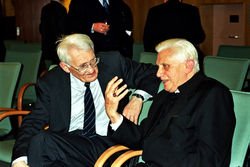 Recently James posted a comment about Pope Benedict XVI's controversial speech. A while back I mentioned that the Pope had been in dialogue with a modern left-wing philosopher called Jurgen Habermas (left). It turns out to be fascinating.
Anyone who is interested in the meeting point between the paths of faith and reason should read this excellent article from Prospect magazine.
Thursday, October 05, 2006
Names
After considering the many suggestions put forward, I've decided to change the name of this weblog to "At the Crossroads".
It suggests the importance of sometimes stopping to re-assess, and an informal meeting place where important matters can be considered. It suggests a place from which to view options. It says something about the significance of this moment in the history of the School, almost 70 years on.
Maybe (although I didn't think of it at first) it might remind you of the new premises of the London School in Mandeville Place.
Thanks to everyone who offered their suggestions.
Two Cheers For The Uncharismatic Leaders!
Following on from some of the conversations in recent posts, I'd like to show how a principle can and should be examined in practice. This isn't contradicting what anyone else is saying, but clarifying my own view.
Let's consider the idea that a principle is "a thorn to remove a thorn; when you have made use of it, you throw both away".
It's not a difficult concept in theory, but in practice it seems to cause people all kinds of problems. Let's assume that this idea is true. It describes a finite process. But how long should it take? Either (a) until full self-realization; (b) until a stage of understanding is reached beyond which the individual is capable of independent reason; or (c) until the Teaching has been heard in full and is intellectually known about.
We can dismiss (c) because we know that intellectual appreciation is not enough. We have to make use of the Teaching to remove the thorn of ignorance. We can also dismiss (a). It would be unreasonable to say that the Teaching should be carried about with us forever like a crutch. Not only that, it conflicts with the tradition of the teacher giving the student rahasya and sankalpa - the secret knowledge, and the ability to decide things independently. At this point, the student is no longer a student, but an independent seeker. So if we believe in the tradition we have to accept that at some point between the extremes of total ignorance and total enlightenment, we make use of a thorn, remove a thorn, and then throw both away. There may be more thorns of ignorance and therefore more thorns of knowledge needed. It's a matter of little steps in knowledge, but little forward steps.
If we look at how things are in the School, it might seem as though almost no-one has achieved such a thing. The tutor reads something to the group. The student asks a question. The tutor re-reads the passage. Another question. Another re-reading. How many tutors can hear what is being said and understand it? How many are clear enough about what is being said to explain it in their own words? His Holiness said, "no-one needs to bind himself to a word". How many of us have transcended the word by finding its meaning?
The only way to come at this is to look at examples of apparent transcendence. We are not talking about full self-realization, but about where someone seems to know something independently. There are a few candidates - I've mentioned Mr Jaiswal before; I might also mention Shane Mulhall, whose talks I've been listening to recently. It's a funny thing, but he stands out in that he doesn't really stand out. He's kind of ... uncharismatic. He has a sad, sonorous voice, and a strange gasping laugh when he tells a joke. From his descriptions of his life (most frequent word used "pathetic") he spends time watching football on the TV, he worries about what suit to wear, and loses arguments with his wife and children. In short, he's an accountant.
Why, then, is he so universally loved and respected? It's obvious. He knows what he's talking about; he speaks from the heart; and he lives by his words. Cut him any way you like: you can read the principles of the teaching there like Brighton rock. You might not agree with everything he says, but he doesn't mind that; nor does he imagine that he's got all the answers because he has the books on his shelf. He quotes His Holiness liberally and faithfully, but with a light touch that only comes from knowing the truth of it for yourself. The result? Someone told me the other day that there are 14,000 students in the Irish School. I've no idea whether that's true, but if so it's a great testament to what can be done.
The problem with charismatic leaders is that you can't do without them. We have a few of these types knocking around - masters of the world etc etc - and the problem is that once you accept their help they make you dependent. In the end, it's not very attractive. The real teacher doesn't make you feel how wise they are, but gives you a glimpse of your own native wisdom. The real teacher sets out to make you equal to himself.
But to come back to thorns - how many of us have forgotten that the Teaching itself is a thorn, and that life is not about the Teaching? How many of us have neglected our Self, in our anxiousness to praise the Teaching about the Self? How many of us have bound ourselves to a word? The Great Men who trumpet their virtues don't do that. Neither do the wise. It's the rest of us, rubbing along together in the lowing herd. That's how we keep ourselves the same.
Wednesday, October 04, 2006
Change
“Great minds discuss ideas;
Average minds discuss events;
Small minds discuss people”
~ Eleanor Roosvelt
Much to my surprise I recently heard a someone in the school use the 'L' word; logic that is. The point was that it is a basic premise of logic that you cannot go from the particular to the general. The above quote came to mind and the thought arose that if we start to generalise from the basis of particular people or events then want to create change on that basis then that is a shaky foundation to start from.
If there are problems at the level of people and events (I come across loads including experiencing myself on an average day) then the question must be, "How do we get back to a true understanding of the IDEA, the principle?". This may or may not involve change.
What concerned me about V's last post was the possibility that too many people focussed too much on change means taking your eye off the changeless. I don't aim this coment at V personally, just something that concerns me generally. I also relate this to the notion of the name for the blog being, "A School for Today and Tomorrow". The effect it creates here is to think that the blog is some kind of think tank that is going to suggest what the school should be. That may not be the intention but that is how I hear it.
From a more practical point of view when I first started going on residentials, I was asked to wear a suit and tie. Initially, I never gave it a thought as to whether this was good or bad. Just accepted it. Now, my preference would be not to. But to get caught up in arguing about whether it's good or bad is perhaps not a very good use of the mind? It's fairly superficial one way or the other. And the more the mind gets caught up in the details, the arguments, and remains focussed on this then does the changeless get forgotten?
Some might say here that I am advocating doing nothing. Well I am well practised at doing nothing but that's another matter. I feel and it is the experience that a principle deeply understood leads to inevitable change (or inevitable confirmation that what you are already doing is correct). This cannot be a purely theoretical/intellectual grasp of a principle but something that has penetrated into the being, the 'emotional truth' spoken of elsewhere. For example, I became vegetarian on the basis of health and of minimising harm to other beings. The principle was felt as well as thought, then the change was inevitable from this. It has never really been a practise or a discipline, more like a change of behaviour that results from something understood. The converse side of this is to make change without having deeply understood. Maybe it is the correct principle but the results are temporary or shallow or maybe even detrimental.
I just want to make it clear that I am not personally calling for any particular change, nor do I feel qualified to do so. But I do want to question. I want to question because I want to understand. I want to get back to the true idea, the true principle. And I am sure that there are others in the school who already understand the principles better than I do. But as has been said elsewhere, being told the 'right' answer is of only partial use and can even result in unhealthy passivity or 'shallow' change as described above. So I want to question, not to change things. But this also does not deny the possibility or change arising naturally from understanding.
